
I’ve been cleaning out my study this weekend and currently it looks like this. If you turned me upside down and shook out the contents of my brain, you’d see a similar chaos. But I’ll be sorted out and back to posting soon!

I’ve been cleaning out my study this weekend and currently it looks like this. If you turned me upside down and shook out the contents of my brain, you’d see a similar chaos. But I’ll be sorted out and back to posting soon!
For all of our growing-up years, my younger sister and I shared a bedroom. We painted two of the walls apple green and two of them buttery yellow. We slept on sturdy old metal army bunk beds, which we spray-painted sunshiny yellow and alternately bunked or un-bunked throughout the years as we rearranged furniture to try to squeeze more real estate out of our tiny room.
Thrift store scavenging and one-of-a-kind flea market finds were family obsessions, so when I was in high school and I found an old metal typewriter table at a yard sale for less than $20, I was stoked. I spray-painted it pink, and together with a print of my favorite Claude Monet painting, it perfectly accented our little green-and-yellow room.
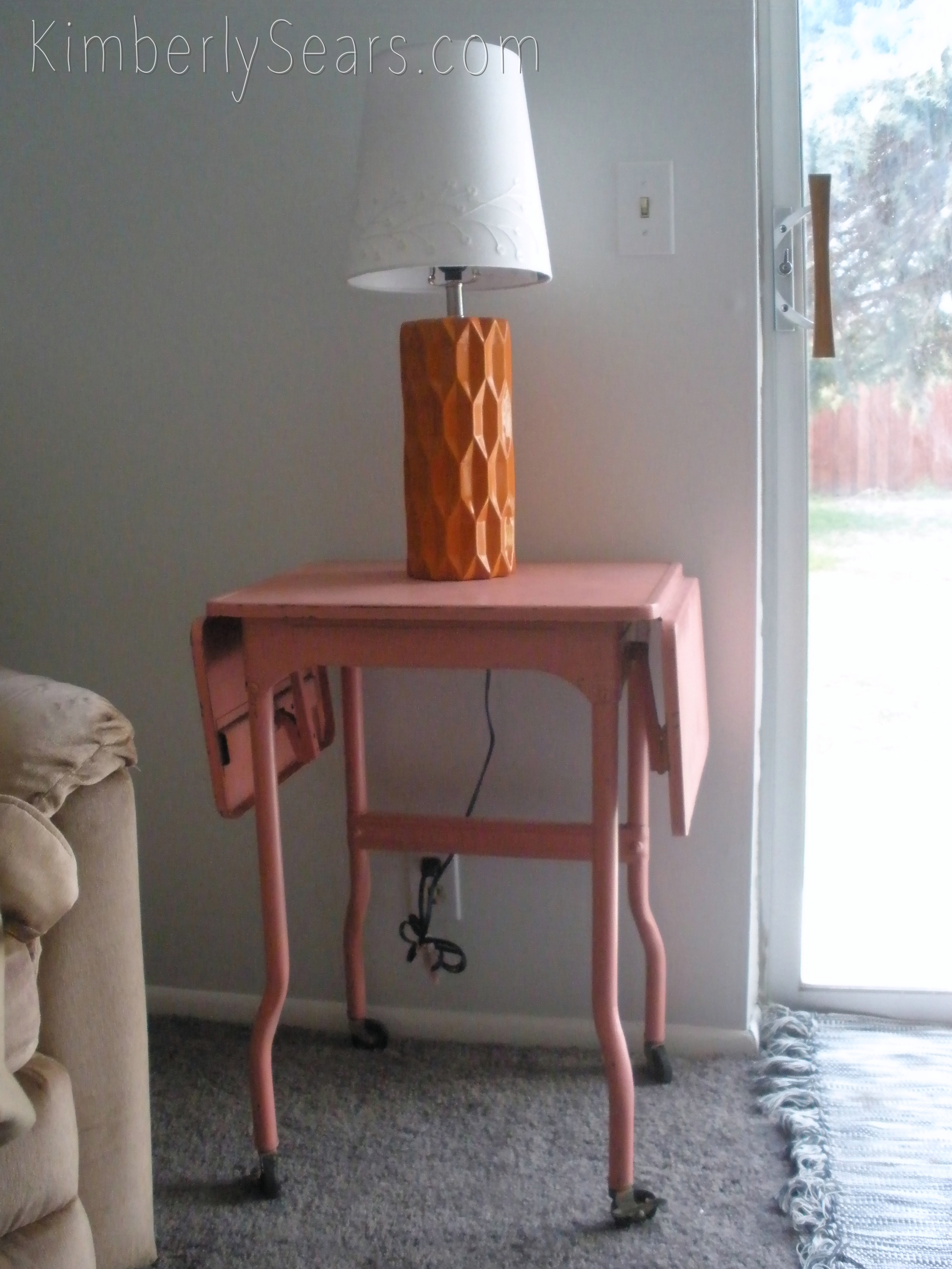
When Mark and I moved into our house, I dug the beloved typewriter table out of my parents’ garage and brought it with me. But the pink color didn’t work with the orange and blue color scheme that carries through our kitchen, dining room, and family room, so I knew that I needed to re-paint it. I decided on a deep, dark, jewel-toned blue.
When I carried the table out to the backyard to spray-paint it, I was hit with a wave of nostalgia for years and years sharing clothes and pedicures and silly dance parties with my sister in our little green and yellow room. I almost couldn’t bring myself to paint over the pink.
But it had to be done, so I sanded the table, wiped it down thoroughly, covered the casters with painter’s tape, and set it on a plastic drop cloth on the grass.

After applying one thin coat of paint, the table looked…like an Easter egg. By the second coat it looked more navy blue, solid, and industrial. The way a typewriter table should look. Not like an Easter egg. You know?

Why is my shoe in the picture, you ask? Because when you’re spray-painting furniture in your backyard and the wind kicks up, you don’t stop painting to grab some rocks. You just kick off your shoe and use it to hold down your plastic drop cloth. Obviously.
All finished, the jewel-toned blue of the table complemented perfectly the bold orange accessories in the room.

I even got around to cutting foam board, ordering glass, and hanging up the vintage 1936 “Visit Palestine” poster I bought in Jerusalem six years ago.

And the best part is that on evenings when Mark and I are both writing, we can drag the typewriter table anywhere in the house, perch a laptop on it, and…type on it. That’s what it’s for, after all.
Seventies style sometimes gets a bad rap. Avocado-colored refrigerators and dark brown thick-piled carpet aren’t everyone’s cup of tea, and city recycling programs have pretty much made trash-compactors obsolete. But can I tell you a secret? I love seventies style. Our house was built in the 1950s but later received a snapping seventies renovation. I love love LOVE my orange kitchen cabinets. I love that we have an old intercom system that no longer functions, so that when we push the buttons it emits a screeching noise that Mark calls our “pet baby velociraptor” and introduces to any kids who come to visit. I love it all.
And I really, really love our light fixtures! Old school fixtures just have so much personality.
This one hangs in our bedroom over the foot of our bed.

Mark has lovingly christened this the “Deseret disco ball” for its honeycomb-like design. I love it for its West Elm kind of bold yet understated style.
These hang over the mirror in the master bathroom.

The rubbed brass and heavy chain contrast perfectly with the airy aqua color I painted the bathroom. And I love having bright lights right by the bathroom mirror!

The orange chandelier is my favorite because it’s just wicked cool. Once someone asked me what we planned to do about our orange chandelier and cabinets, and I just laughed because I LOVE THEM so much. They are what I would choose if I were building my dream home tomorrow.

Like every other aspect of our house, these fixtures were an enormous amount of work because of how filthy they were. There was a yellow-brown film of tobacco smoke stain over every surface imaginable. Cleaning each fixture took several hours (and I could probably clean them better still).
To give you an idea, see the white candlestick parts of the orange chandelier? Yeah, before I cleaned them we thought they were orange, too. The orange parts themselves? They were the color of rotting fall leaves, and when I scrubbed off the grime I was tickled by the bright orange revealed underneath.
The big round fixture in the bedroom was one of the worst, since the previous owner of our home smoked so much in her bedroom (she smoked so much in every room of the house, but the bedroom was one of the worst). We actually thought the fixture had brown stained glass; then one day when my mom came over she took the fixture down, scrubbed the whole thing with hot soapy water in the sink, and POOF! It was actually translucent white glass under the nastiness all that time.
I’m so glad that under all the filth there were bold bright designs with enduring style and staying power. These guys are stayin’ alive.
When I was a kid sometimes I felt like inanimate objects had personalities and feelings. I guess I just read and watched A Little Princess too much, because if I realized that I’d been neglecting one of my dolls or stuffed animals I’d feel guilty and do my best to make it up to him or her. I thought I was the only one who had this quirk until Mark confessed the same thing. To this day, if he has several pens in his school backpack, he feels a compulsion to use them all equally “so that no one feels left out.” He blames this silly sentiment on Toy Story.
I really really really love wearing scarves, and it’s always a bummer to find a scarf that was shoved to the back of a drawer and forgotten for several months. It’s like missing out on the company of a good friend (okay, just kidding). I determined that I wanted my scarves stored on the wall on a shelf where I could see and love and wear them all.
For a time, while I hunted down a shelf, my scarves were all in a pile on the floor.

But then I got a cheap shelf from Target.

And now my scarves look like this!




Today Mark’s family returned home to California after spending a long weekend visiting us here in Utah.
A month ago, on our way to Tel Aviv, we visited them.We had a long layover in Los Angeles, so everybody was nice enough to take the day off and pick us up at LAX for a day of family fun.
We explored Santa Monica and ate lunch on the boardwalk, then enjoyed the sunshine and the Ferris wheel on the Santa Monica Pier.










Thank you, dear family, for always making time to have fun adventures with us! We can’t wait for the next one!
My friendship with Samantha goes back to eighth grade, when we played night games with other neighborhood kids every summer night and did not maim ourselves jumping from the tree house onto the trampoline in her backyard. In high school we survived dominated AP Language, AP Literature, AP European History, AP US History, and AP US Government together. Later we attended different universities, but we corresponded and kept up through college craziness, summer study abroads, and dating drama. Now we both have husbands and she has a baby, and we’re still the best of friends.

Samantha just stitched this lovely gift for me! (How she found the time to do that with a new baby, I have no idea.) These sweet little birds are the perfect addition to our built-in bookshelves. They make their nest with the gorgeously illustrated old copies of Oliver Twist and Journeys Through OZ that Samantha gave to me. And see that book of Portuguese love sonnets? That was a wedding present from Samantha and her husband. I think Mark and I will take a leaf out of their book and start reading love poems together for date nights sometimes. John Donne, here we come!
A friend who shares your obsession with old books, who has read everything under the sun and always has great reading recommendations? A friend who hand-stitches a thoughtful gift for you just because? A friend whose constant friendship has endured more than a dozen years? Very lovely indeed! Thank you, Samantha!

Signed copy of the Alhambra Decree, or Edict of Expulsion
It’s nearly 10 pm, but I can’t let March 31st pass without writing a note on this immensely important moment in history.
In 1492, Columbus sailed the ocean blue. And Fernando and Isabel issued the decree that sealed the death of the Golden Age of Spanish Jewry and changed the course of history for Sephardic Jews, Spain, the Mediterranean, and the world.
So let’s see if I can give a rundown on this decisive day in less than a thousand words and less than twenty minutes.
Jews lived on the Iberian Peninsula since Roman times. Spanish and Portuguese Jews, or Sephardim, enjoyed great opportunities and relative freedom from persecution under Muslim rule; this medieval period is known as the “Golden Age of Spanish Jewry.”
For almost a thousand years Christians and Muslims fought for the control of Iberia in the Reconquista (reconquest). Generation after generation, the Christian kings drove farther and farther south until Moorish control was confined to the southern region of Andalusía, and finally to their last stronghold: Granada.
With the combined might of their newly allied kingdoms, Fernando and Isabel made the war on Granada their special project. After months of siege, the fight was over. The Moors surrendered Granada on January 2, 1492.
Three short months later, Fernando and Isabel turned their attention to another thorn in the side of their united Catholic kingdoms: the Sephardic Jews.
The persecution of Jews in Castile and León was not new; over a decade earlier the king and queen had obtained a Papal Bull to establish the Spanish Inquisition. It was not the first inquisition in Europe, but it was unlike anything that had preceded it, because instead of functioning as an arm of the Catholic Church, the Spanish Inquisition was under direct supervision of the monarchs, and it was the first national institution of united Castile and León.
But what happened on March 31, 1492 surpassed any previous persecution and rocked the Sephardic world. Fernando and Isabel issued the Alhambra Decree, or the Expulsion Edict, that called for the expulsion of all Jews from the realms of Castile and León. Spain’s flourishing Sephardic population was left with three choices: leave the land where they had lived for more than a millennia, convert to Catholicism, or face death.
Pope Alexander XI would later award Fernando and Isabel the title of “los reyes católicos,” or the Catholic monarchs, for their defending of the Catholic faith within their realms. But was it only religious piety or also politics and practicality that motivated the Expulsion Edict? After decades of warring with the Moors, the Castilian crown’s funds were all but depleted (tradition holds that Isabel pawned her own jewels to fund Columbus’ historic voyage). When the king and queen needed money to finish their campaign against Granada, they turned to wealthy Jewish merchant and financier families who had money to lend. Some historians argue that for the king and queen, it was easier to expel their creditors than to pay them all that was owed. Whatever the motivations, the edict forced an estimated 200,000 Sephardim to leave Spain and tens of thousands to convert to Catholicism on pain of death. Spain and the Sephardim would never be the same.

I’m a wide-open spaces kind of girl. I love living ten minutes from the heart of our big city and I love all that it has to offer, but sometimes I need the restorative peace that I feel in a quiet, outdoor place where few other people tread.
Our time in the Holy Land was no different. After our 31-hour travel ordeal and two days running around Jerusalem at breakneck speed trying to see everything, we were tired and needing a breath of fresh air. What to do? Why, run away to Galilee, of course!
We revisited all my favorite spots and hit the Galilee highlights: Capernaum and the white synangogue, Tabgha, the Mount of Beatitudes, Tiberias. And best of all, we discovered a new place that we love, recommended to us by our dear friends who gave us lodging on our trip. Now that I’ve experienced how enchanting this place is, I can’t believe that 1) this place only has a stub of a wikipedia page, 2) most visitors to Galilee never even go there, and 3) I lived four months in the Holy Land without ever finding out about this gem.
So the word’s not out yet, but shhh! I’m about to tell you, if you can keep a secret. It’s the Greek Orthodox Church of the Twelve Apostles in Kfar Nahum, or Capernaum, on the shore of the Sea of Galilee.

I can’t even tell you how enamored I am with this place. I fall hard for churches, but this one swept me off my feet before I even knew what hit me. (If you go, please leave a small donation of at least a few shekels, because one wing of the church is undergoing costly renovations right now.)
The grounds were unrivaled in terms of how well-kempt and beautiful they were. Orchards of citrus trees, rows of stately cypress trees, and walks covered in grape arbors surrounded the church. The hedges and the stone walls around the grounds hung thick with honeysuckle and fuchsia bougainvillea flowers. From the moment we crossed the threshold of the gate, we were bewitched. We were greeted by the most sumptuous citrus aroma I have ever smelled. And by several strutting peacocks.


I didn’t think it possible that the inside of the church could surpass the outside in loveliness, but it did. When we crossed the threshold of the church I audibly gasped because what I saw was so beautiful—resplendent ornamentation and chandeliers, and the most stunning iconography I have ever seen.
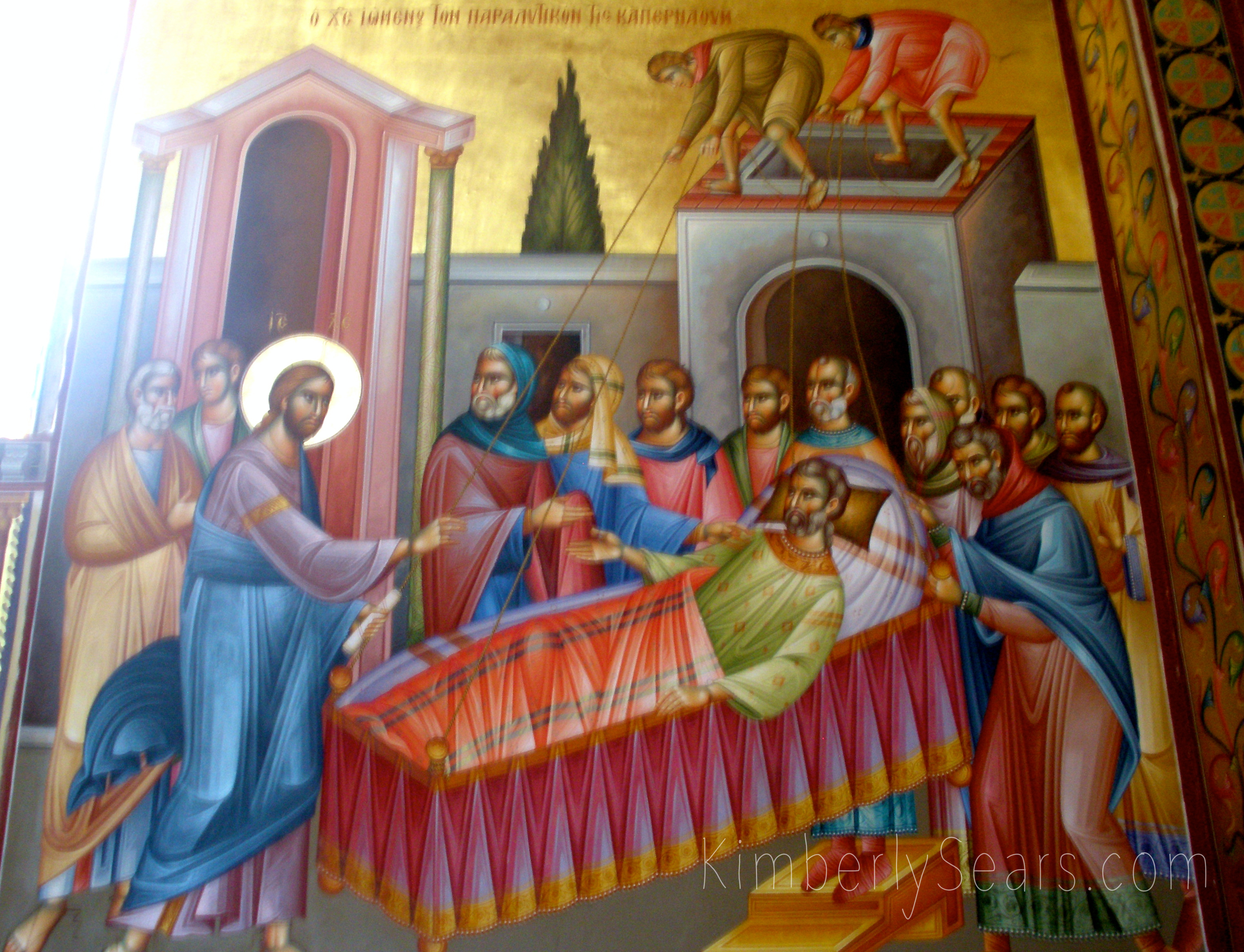
I’m so sorry that this shot is a little blurry! But don’t you love this icon of the paralytic man being lowered into the house where Jesus will heal him? I do.
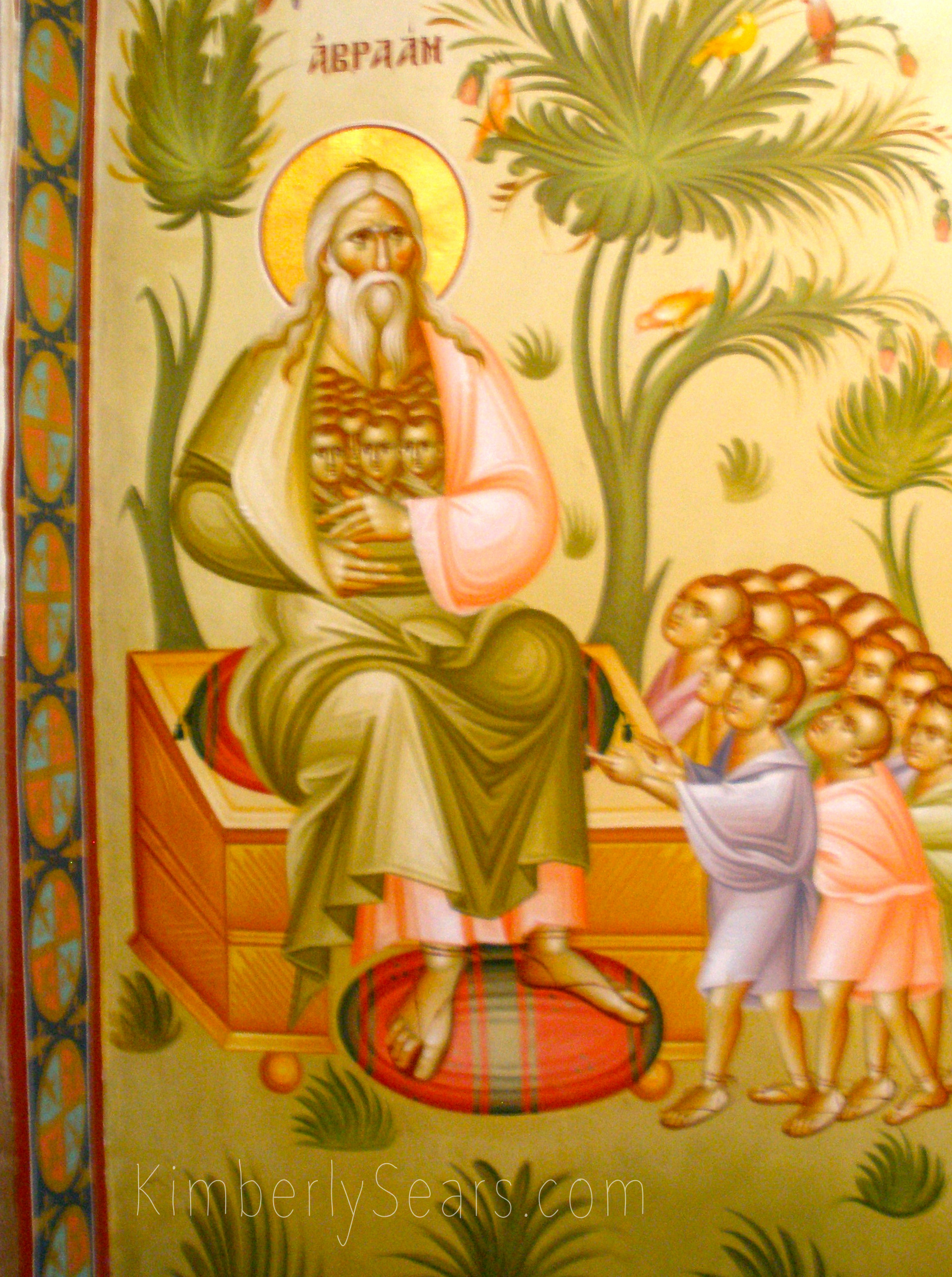
The faithful being gathered into Abraham’s bosom; note the name Abraham displayed in Greek.
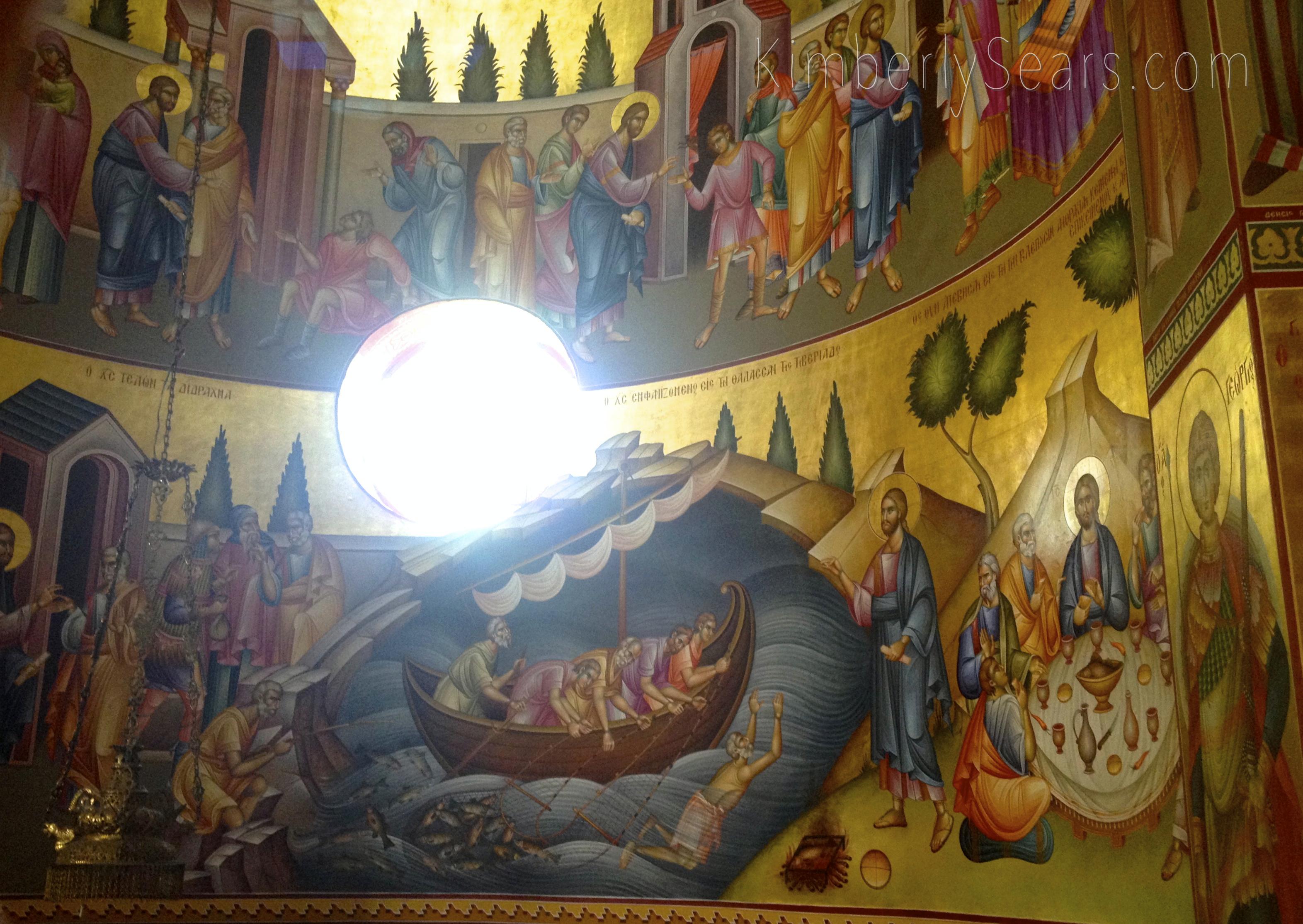
Remember after the Lord’s crucifixion and resurrection when he gave Peter the injunction to feed his sheep? According to tradition, that occurred on the northwestern shore of the sea, not far from here, so this icon commemorates that event. Do you see the disciples pulling their catch into the boat? And see how Peter has jumped overboard and is swimming to the shore, where the Lord is waiting with the fire on which he will cook their breakfast?
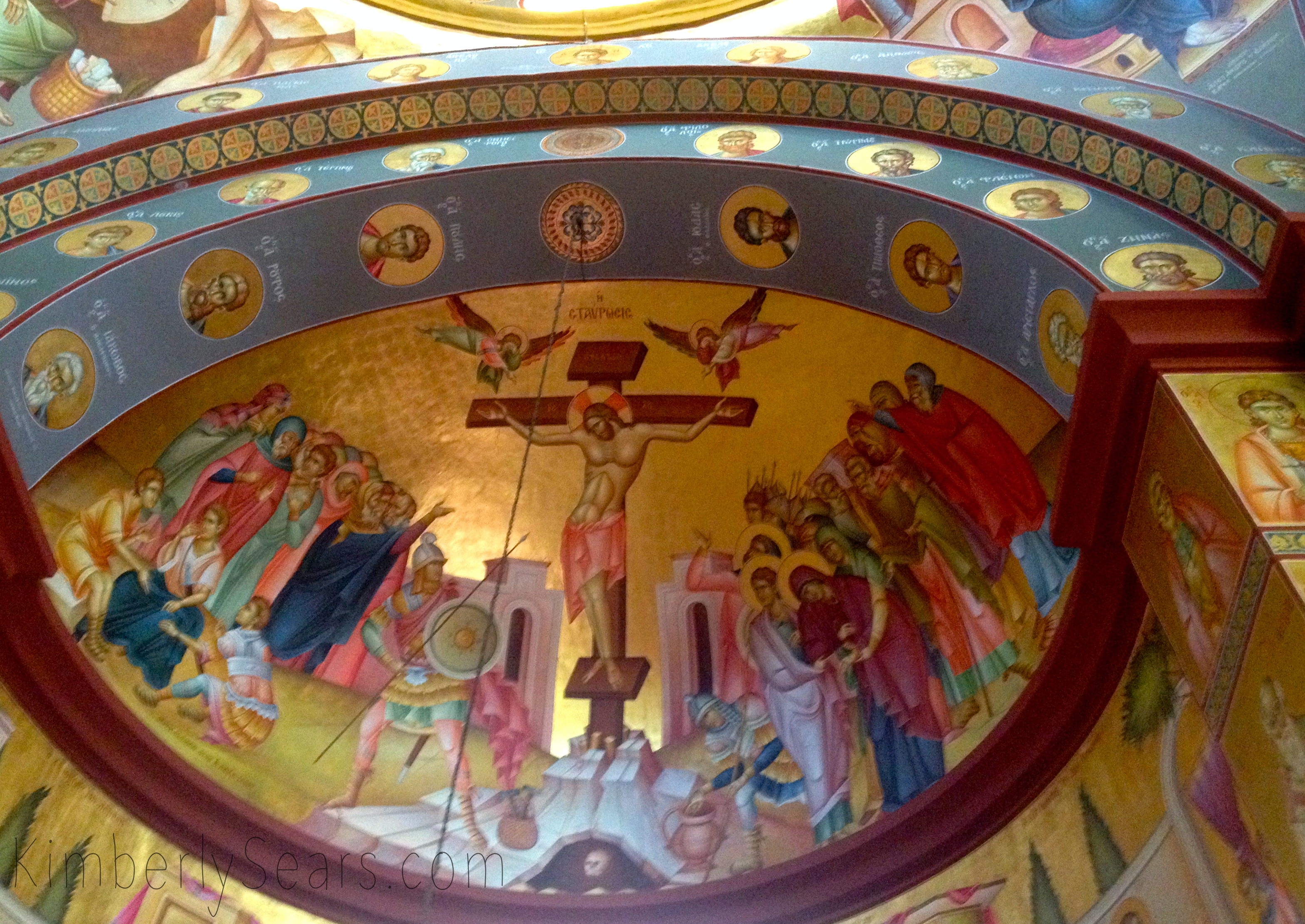
All around the church’s domed ceiling appeared icons of the twelve apostles and portraits of the faces of the seventy apostles, as they are called in Eastern Orthodox tradition.

The information posted in the church told us this about its history:
“On the shore of the Sea of Galilee there is a Greek Orthodox monastery with a beautiful church in honor of the 12 Apostles…It is here that our Lord Jesus Christ chose and called forth His Apostles, here He preached and performed miracles, such as the healing of the paralytic, the mother-in-law of the apostle Peter, the servant of the centurion and many others. Here in the times of Christ was the city of Capernaum.
“In the IV century AD many monasteries and churches were built in the places where our Lord lived, taught, and performed miracles. By the V century the Christian community of Capernaum had grown very big. However, in the first half of the VIII century the flourishing city of Capernaum was completely destroyed by an earthquake.
“Archaeological excavations on the city’s site show that there was a large orthodox monastery here on the shore of the Sea of Galilee. At the end of the XIX century the Greek Orthodox Patriarchate of Jerusalem purchased a plot of land on the ruins of the ancient city of Capernaum and began to construct a monastery. In 1925…the Church of the Twelve Apostles was built. Services were held in the church until the founding of the state of Israel in 1948. According to the U.N. convention and the new borders, the monastery turned out to be on no man’s land. Therefore, there was no more access to the monastery for local Christians or pilgrims and the monastery fell into decay. In 1969, two years after the Six Day War, the Israeli army returned the monastery to the Greek Orthodox Patriarchate of Jerusalem. With the grace of God, despite the fact that it is fairly isolated, the monastery began to return to life.”
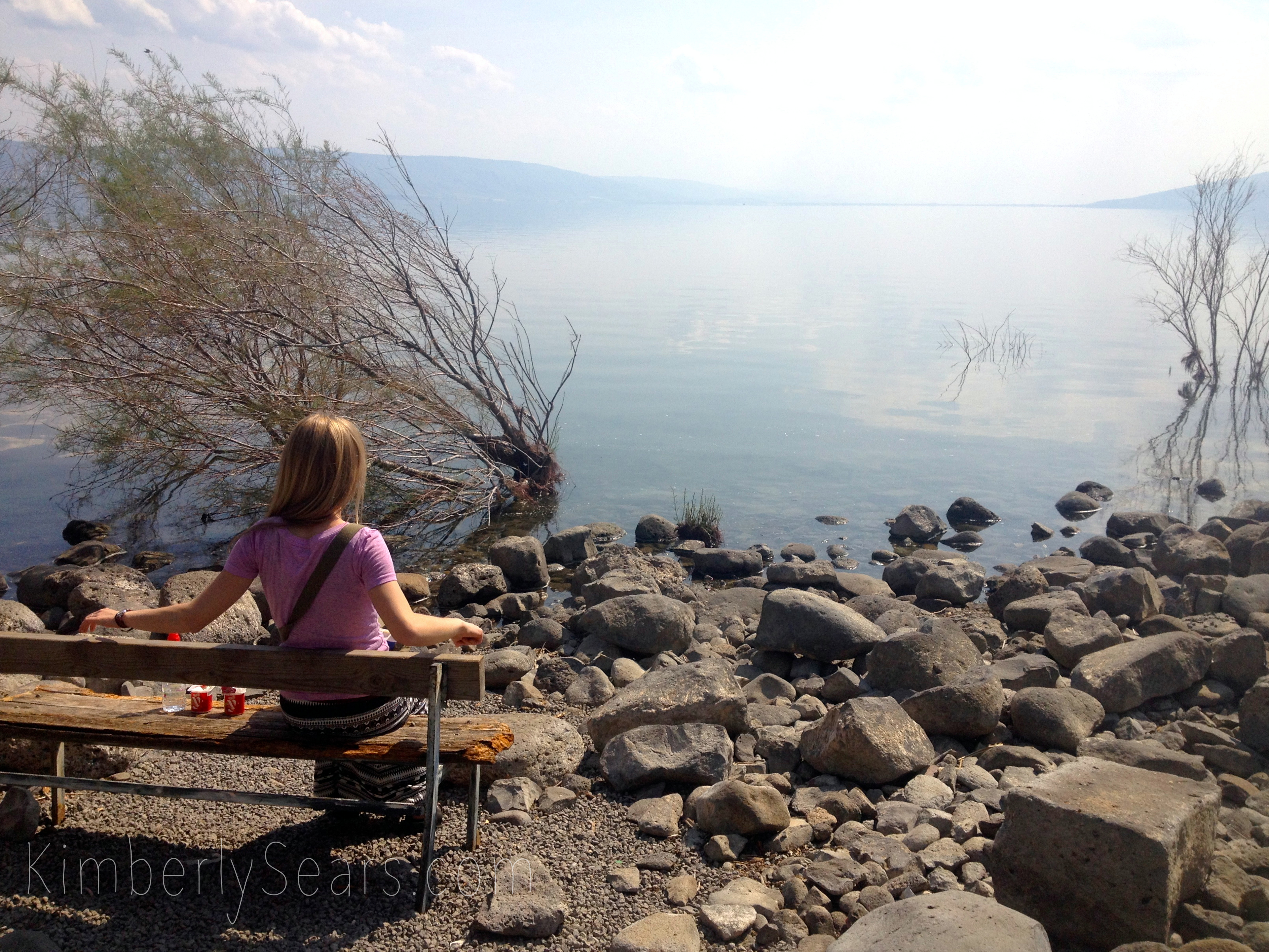
After partaking of the iconography within the church, we spent some time picnicking on the grounds, and walking along the shore.
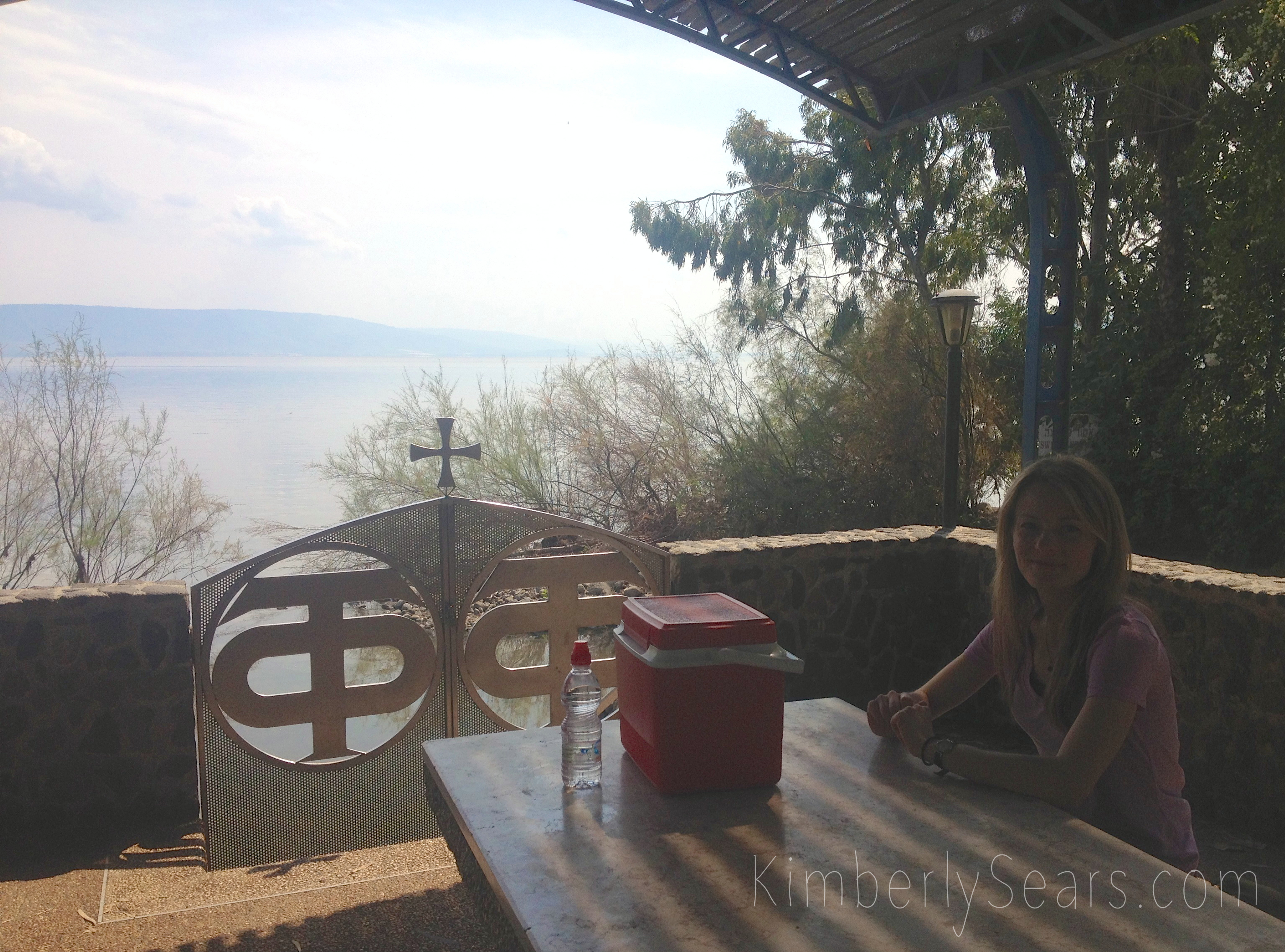
We picnicked in this lovely spot on the church grounds. See that gate? Behind it are steps that lead down into the water!

I delighted in the beauty of this site, and reveled in the profound peace and stillness I felt there. The Church of the Twelve Apostles is unlike anywhere else in the Holy Land, and for me it will always be a sacred place.

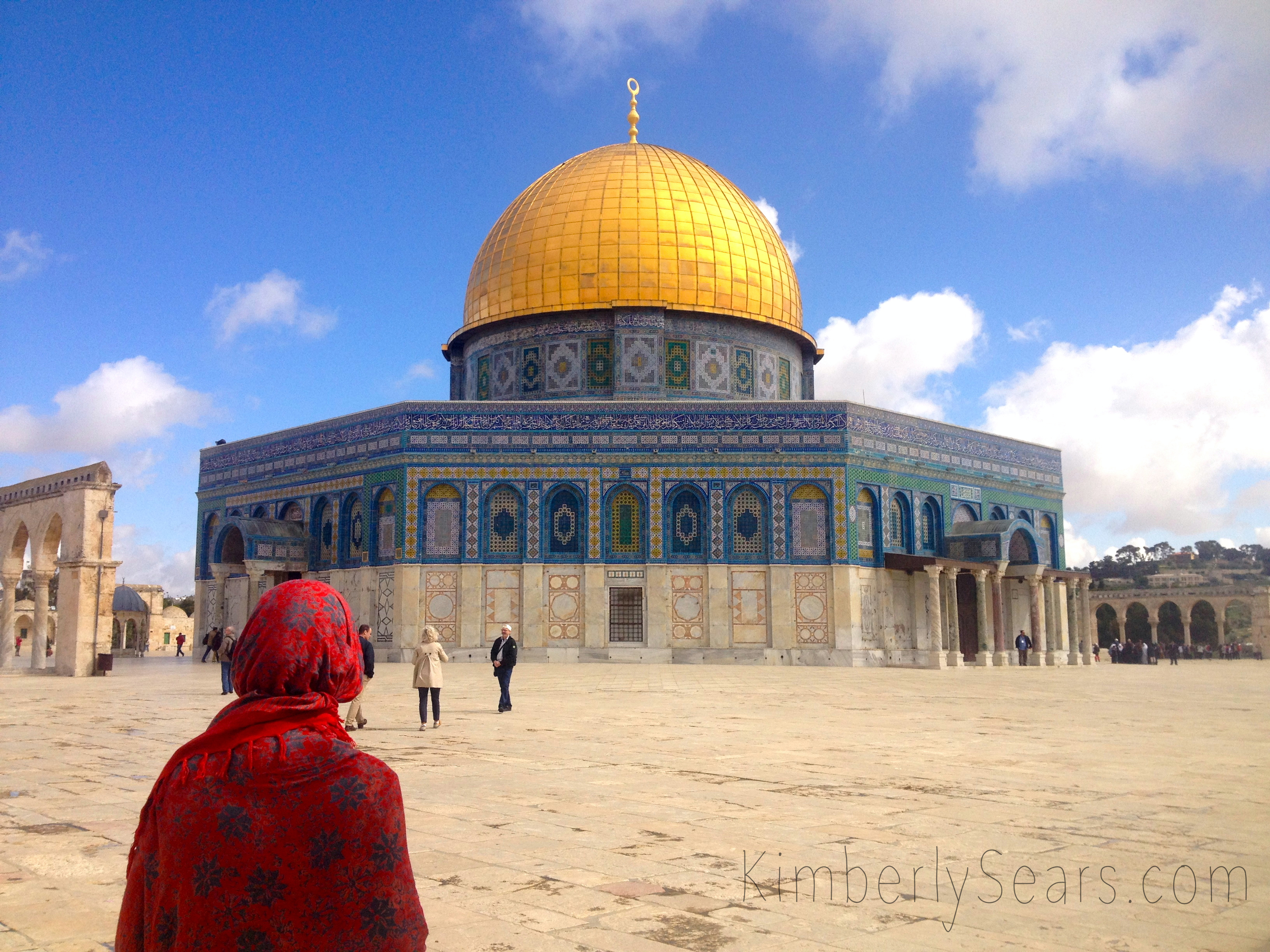

Haram Al-Sharif, or Haram Esh-Sharif, means “noble sanctuary” in Arabic. It couldn’t be more appropriately named; the disparity between the Temple Mount’s serene grandeur and the cacophonous crowded streets below couldn’t be more marked. When you ascend to the Temple Mount, you ascend to a world apart.
Home to the iconic Dome of the Rock, often referred to simply as “the Mosque,” this has always been one of my favorite places in the Holy City.

A Muslim guide, a Jerusalem native, approached us and offered to show us around, and we took him up on his offer. His knowledge of the history of Haram-Al-Sharif, and Jerusalem in general, was impressive. He walked us around the entire Temple Mount, structure by structure, relating little-known facts about their significance and history, such as these:
Many more things we learned from our guide in the half hour he walked with us—including the architecture lesson he gave us, pointing out different minarets on the Jerusalem skyline and teaching us how to distinguish the ones built by the Ottomans from those of Mamluk make.

But the most meaningful thing I learned from him had to do with the pillars of Islam, specifically that of Hajj, the mandate to make pilgrimage to Mecca at least once in one’s life. “When you go to Mecca, millions of other people are there,” he explained. “You feel very small, helpless, and insignificant, just like you will feel before Allah on the day of judgment, when you stand before him naked with your sins. So you go to make Hajj, and you truly feel how you will feel on judgment day, and you come back knowing what kind of person you want to be, how you want to change your life.”
If you’ve been reading my blog for a while, you know how much I cherish the idea of pilgrimage–going to a holy place or making a sacred journey to come into contact with the divine. I love how beautifully our Temple Mount guide articulated why one should make pilgrimage, and what can be gained from it—how you can be transformed by going to a place as holy and ancient as Haram-Al-Sharif and feeling how tiny and young you are on this earth.

Happy Purim, everyone! Purim is one of my very favorite Jewish holidays for the following reasons:
1. It memorializes the beautiful queen Esther whose bravery saved her people, and it commemorates the Jews’ deliverance from death and their victory over the jealous Haman. Esther’s story has always been one of the most beloved to me.
2. Everybody gets dressed up in costumes for Purim!

Two boys in costume, one dressed as Ironman and the other as an army soldier, walk down a street of Mahane Yehuda, the Jewish Market. Every year Purim costumes become a little more Americanized. Mark took this photo.
The Book of Esther tells us that after the Jews were spared from death and their would-be exterminator Haman was slain, they instituted a holiday on the 13th and 14th days of the month of Adar (Purim is celebrated one day later, on the 14th and 15th, in walled cities such as Jerusalem). The first day of the holiday is observed as the fast of Esther to remember when Esther and all her people fasted before she dared come before the King Ahaseurus and make her request to him. The next day is the celebration of the Jews’ deliverance.
When is the month of Adar, exactly? The Jewish calendar is lunar and lasts 354 days; in a normal non-leap year there are twelve months of 29 or 30 days. This means that Adar and Purim always fall in February or March. Because of the deliverance of the Jews from Haman, Adar is considered the happiest month of the Jewish calendar. Thus every leap year, when an extra month is added to the calendar, there is a second month of Adar.
While accepted as scripture by Jews and Christians alike, the Book of Esther does not actually mention God’s name—not even once. But his hand can be seen in the story of the deliverance of Esther and her people and so it is said that he is “disguised” in the story. For that reason, many Jews celebrate Purim by donning disguises; instead of the usual somber black apparel, you can walk down the streets of West Jerusalem and see young people wearing Halloween-like costumes (and showing more skin than I’ve ever seen in the Holy Land).
Purim tradition also includes attending synagogue to hear the reading of the scroll of Esther (the Megillah). Every time Haman’s name is read, everyone boos or shakes noisemakers to drown out the sound of Haman’s name. Another traditional Purim observance is drinking wine until you are so inebriated that can no longer distinguish between the phrases “Blessed is Mordecai” and “Cursed is Haman” (yes, really!). After all, if it were not for the banquet and the wine that Esther prepared for Haman and the king, the Jews would not have been saved!
Mark and I loved spotting and snapping photos of everyone in their Purim costumes! Purim may well be the most lighthearted of all Jewish holidays. Chag sameach!
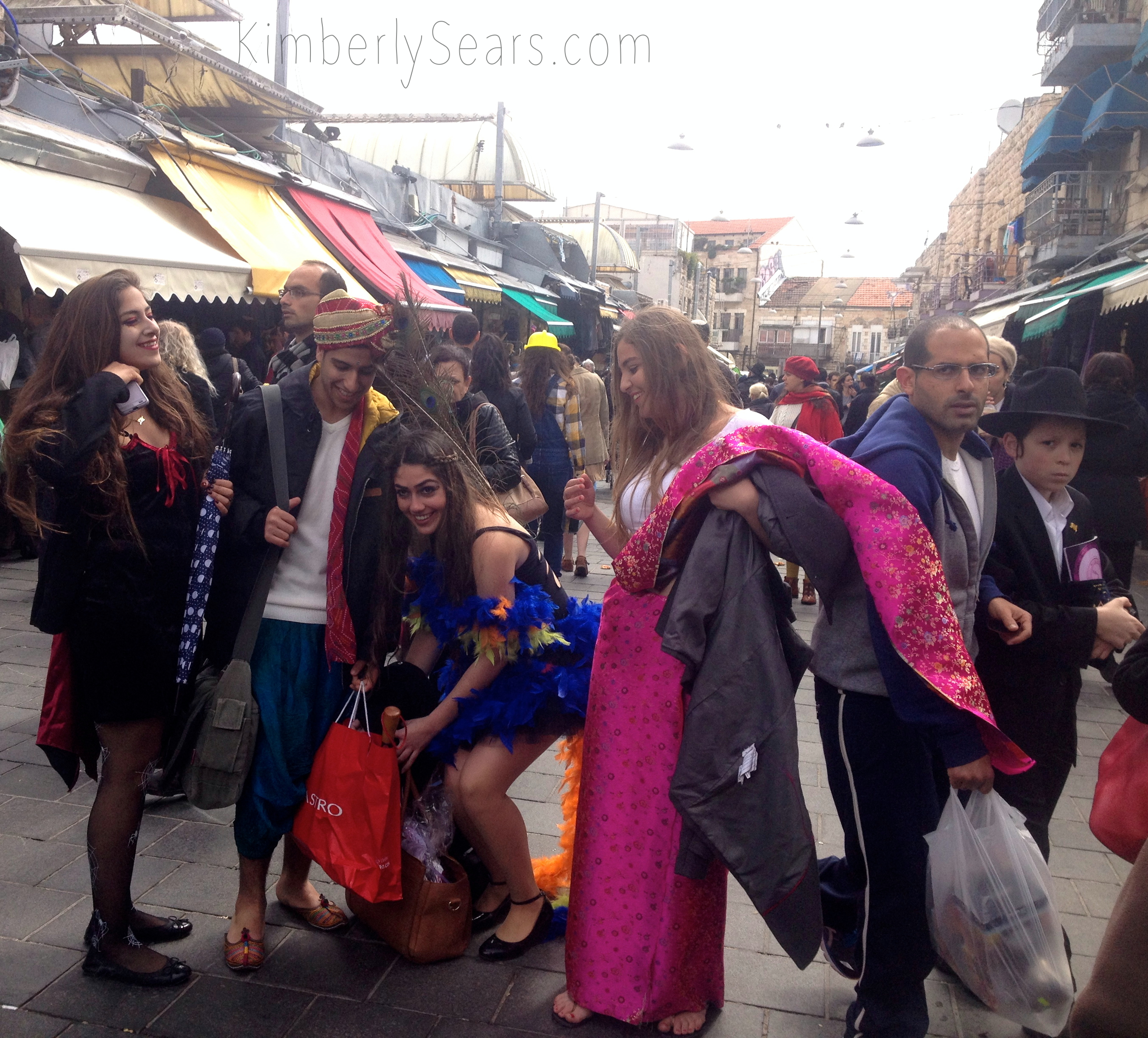
Israeli youth sport their none-too-conservative Purim costumes while a man and an Orthodox boy hurry past on a street in Mahane Yehuda.
 Kimberly Sears