Yad Vashem, the Yeshiva Shooting, and the Conflict

It occurs to me that my blog, up to this point, has been mostly a collection of of happy-go-lucky posts about field trips and vacations, with lots of photos of me standing in front of significant places and smiling at the camera.

Actually, though, living here in Jerusalem has been much more than sightseeing. It has been a learning experience, and a sobering experience as we live among people for whom violence and danger is a daily reality.

About ten days ago, as you may have heard, there was a shooting at a yeshiva, or Hebrew school, across town in West Jerusalem. The killer, who was from a neighborhood near us in East Jerusalem, fired fifty or sixty shots; many people were injured, and eight teenage boys studying at the yeshiva were killed. The gunman was finally stopped when a man from a neighboring building came into the back entrance of the school and shot him down.

Our Hebrew teacher, Judy Goldman, was teary and somber when we saw her in class after the shooting. She told us, “I debated about whether or not I should come to teach class today. But then I remembered something that was said after Virginia Tech. One of the professors that was killed was himself a Holocaust survivor. This man was killed when he blocked a doorway with his life to protect his students. The son of this great man said after his father’s death, ‘In the face of a tragedy like this, you must go on. Otherwise, you let the terrorist win.’ That is why I came to teach class today.”

Mrs Goldman also told us that in Israel, when there is a crisis, people run toward the disaster so that they can help, rather than running away for safety. A few years ago when there was a car bomb, her husband, who is a rabbi, ran toward the explosion. He showed up at the scene and started pulling victims out of the rubble.

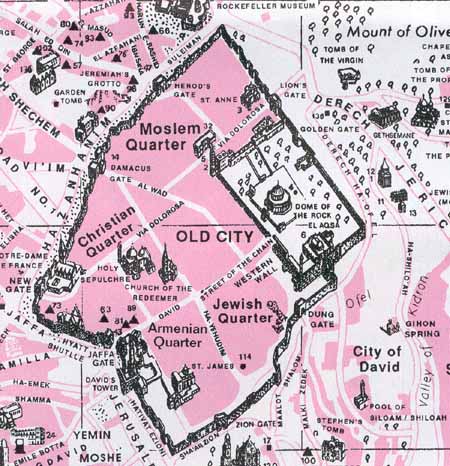
After the attacks, the Jerusalem Center was locked down completely; we weren’t allowed to go out for any reason for about four days. It was a really long four days, especially because before that we had been forbidden to go to the Old City or East Jerusalem because of the Gaza strikes (when there are Gaza strikes, we can only leave the JC if we get a taxi to take us directly to West Jeru; we can’t walk through East Jeru or past the Old City).
We took a trip to Yad Vashem, the Israel Holocaust Museum, a few weeks ago. Some things you might find interesting:

Two-thirds of the SS officers who carried out the mass murder of the Jewish people were college-educated. Most had degrees in law, philosophy, economics, and history. One-third of all the SS officers held doctorates in their fields of study.

“The world was divided between places where they could not live and places where they could not go.” Chaim Weizmann said this of Jewish refugees in Europe in the 1930s.

Posted on a wall in Yad Vashem is this poem:

First they came for the socialists,
And I did not speak up, because I was not a socialist.
They came for the trade unionists,
And I did not speak up, because I was not a trade unionist.
They came for the Jews,
And I did not speak up, because I was not a Jew.
Then they came for me,
And there was no one left to speak for me.

As I was wasting time online, I came across this rather disturbing variation of that poem:

First they came for the fourth amendment,
And I did not speak out, because I didn’t deal drugs.
They came for the fifth amendment,
And I was silent because I owned no property involved in crimes.
They came for the sixth amendment,
And I did not protest, because I was innocent.
They came for the second amendment,
And I said nothing, because I didn’t own any guns.
And then they came for the first amendment,
And I could say nothing at all.
(Illinois State University College of Fine Arts)

Today we went to Bethlehem and spoke to some of the students at Bethlehem University. The West Bank is supposed to be the territory of the Palestinians, but it is not contiguous; it has been broken up by Israeli settlements. In order to get to their classes at Bethlehem U, the students told us, the 30-minute drive takes two hours because of all the checkpoints they have to go to. They are not allowed to move freely in their own home country; it is divided between places where they have to have permits and places where they have to pass through checkpoints.

These are just some of the things that have been on my mind lately; what do you guys think? Let me know!

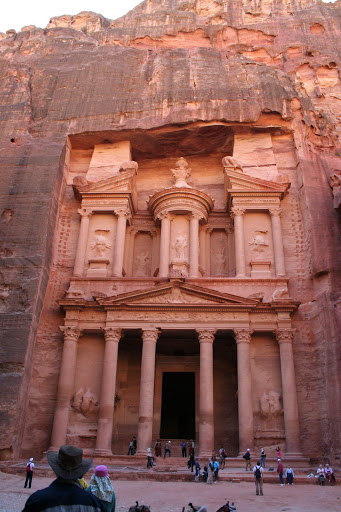
Petra-fied!
The journey into Petra took us through narrow, winding, redrock slot canyons that looked exactly like the ones at home. Then my breath caught in my chest as the canyon opened up and I caught my first glimpse of Petra.

There are some places that you expect you’ll get to sometime in your life: California, maybe Canada, some of the eastern states, and hopefully Europe at some point. Then there are other places that you dream of but never expect to actually visit. Petra is one of those places. As a little girl I read the encyclopedia for fun, so I’ve read about Petra my whole life. But I never imagined that I’d go there!

So what is Petra, exactly? It’s a city carved out of the canyon by the Nabataeans, a desert people that lived during Roman times. Petra was along the King’s Highway, an important trade route, and so the Nabataeans were wealthy traders. The entire canyon of Petra is filled with the temples, dwellings, and hundreds of tombs carved out of the cliffs. In its heyday, Petra was home to thousands of people.

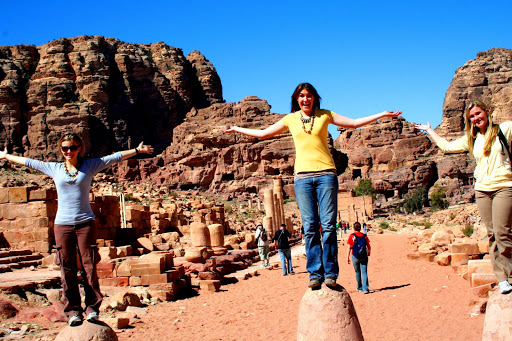
Look! Indiana Jones! Along the bottom of the canyon is an ancient Roman road, or cardo. This building is the first that you pass along the cardo; it’s called the “Treasury”

You can’t tell in this photo, but on the canyon wall behind us there are dozens of little tombs carved out of the rock.

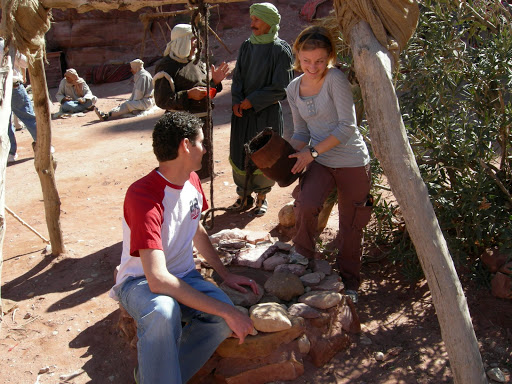
“I’ll fetch water for your camels, too!” In Old Testament times, the well was definitely the place to meet.

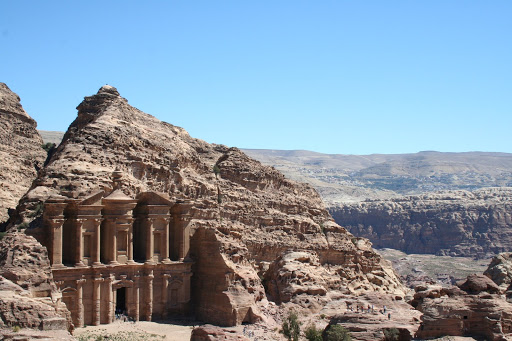
We got to spend most of the day just exploring Petra on our own, so I hiked up to the “Monastery” a few miles up the canyon

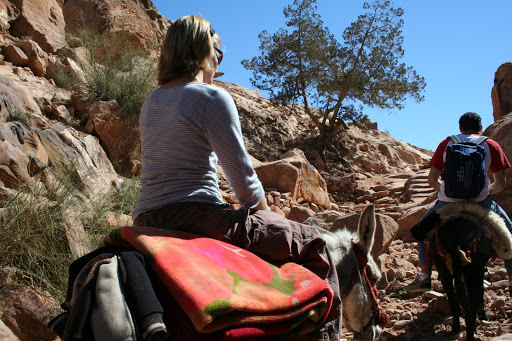
There was only a little time left before I had to catch my horse ride out of the canyon, but I really wanted to go up to the High Place, an ancient Nabataean altar where they performed animal and human sacrifice. So I paid a Bedouin guy $5 to borrow his donkey, and Madison and Dave and I high-tailed it up to the High Place. In some places the trail was really steep! And there were long drop-offs on the side! Riding a donkey up to an ancient sacrificial altar in Petra is definitely in my Top Ten Life Moments.

Looks a little sketchy to me…

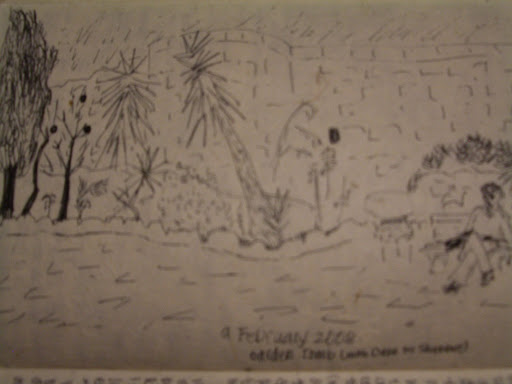
Sometimes I like sketching better than taking photos, because it makes me really stop and see. When my camera ran out of battery in Luxor and I was without it for two days, it was a blessing in disguise because I made a sketch of our boatride on the Nile. The image quality is not very good, but you get the idea:

An expedition to the Garden Tomb with Dave; the Garden Tomb is my favorite place to go on Shabbat

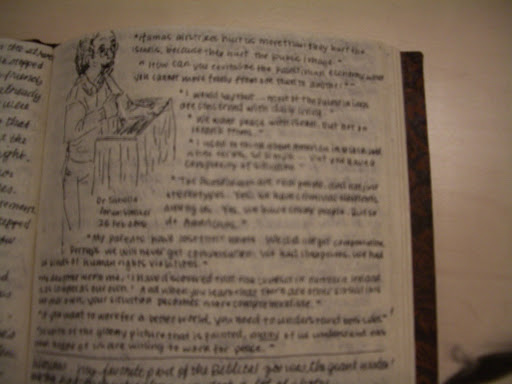
We have weekly forums when guest speakers come and lecture on various topics related to the conflict; here are my notes from last week’s forum, Dr Sabella, a Palestinian researcher.

Well, folks, I’m off on a weeklong excursion to Jordan. I’m pretty stoked, but I won’t have internet access for about five days…so I love you all and thanks to everyone for reading my blog and commenting and just being interested in my adventures here in the Near East. Love you lots!

If You’re Going Through Hell…


All of our imagery of hell (fire, brimstone, torture, etc.) comes from the Hinnom valley, just south of Jerusalem. In Old Testament times, wicked kings like Manasseh and Jehoram offered their children up as sacrifices to the Canaanite fire god Molech. Garbage and refuse was also burned there. The word “hell” is just an English transliteration of the Hebrew word “Sheol,” which is just another name for the Hinnom Valley (it is also referred to as Gehenna).


Inside an ancient burial cave–these are the niches for the bodies

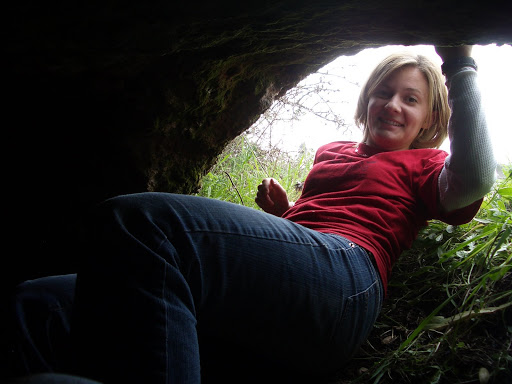
We walked through the Kidron Valley on the way to Hell. Along the way, there were dozens of caves and ancient burial tombs–we weren’t supposed to explore them, but we did. (You only live in Jerusalem once, right? Anyway, the bodies were removed long ago, so it’s not like we were desecrating graves!)


Shimmying into a burial cave


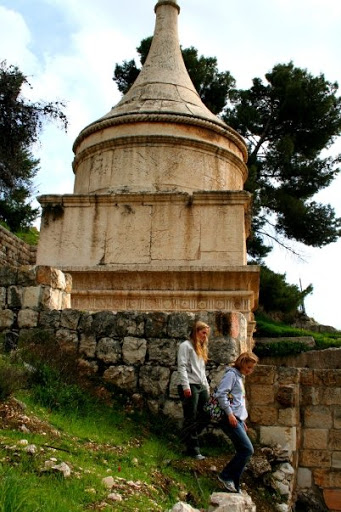
The tomb of King David’s son Absalom, who rebelled against him and was killed by David’s vassal Joab


Sadly, there is no sign or marker that says “Welcome to Hell,” just a stroll through the Hinnom Valley. Kind of anticlimactic, actually. The scriptures say that the road that leads to hell is wide–who knew that it’s actually difficult to find Hell?


Me and my beautiful roommate Brie


A field of poppies in the Kidron Valley (look close–you can see the Dome in the background)

Long Time, No Blog

Hey everyone! It has been a really busy week, full of exams and papers and pulling all-nighters. Consequently, I haven’t posted for a while, so here are the highlights of the last ten days:

BELIEVE IT OR NOT

We had a nice little blizzard here in Jerusalem. Since snow is so rare here, everything in the city shut down and our classes were canceled because none of our professors would come teach–people just don’t leave their houses when it snows here, and there aren’t any snowplows.

AND THEY CAME TWO BY TWO…OR THREE

We went to the Jerusalem Biblical zoo, which has the actual ark built by Noah. Seriously. : )

IN THE VALLEY OF ELAH

The field where David slew Goliath doesn’t have any monuments or churches built there, so it’s easy to imagine the battle of the Philistines taking place there.

Some thoughts I had on David v. Goliath:

“And Saul armed David with his armor, and he put an helmet of brass upon his head; also he armed him with a coat of mail. And David girded his sword upon his armor, and he assayed to go; for he had not proved it. And David said unto Saul, I cannot go with these; for I have not proved them. And David put them off him. and he took his staff in his hand, and chose him five smooth stones out of the brook, and put them in a shepherd’s bag which he had, even in a scrip; and his sling was in his hand: and he drew near to the Philistine.”
-1 Samuel 17:39-40

Because David tended his father’s sheep instead of going to war, he had never worn armor or wielded a sword. For that reason, when he put on the helmet, mail, armor, and sword, he wasn’t used to using it. Even though they were formidable weapons, he hadn’t practiced with them, so he removed the armor and put down the sword and took up his shepherd’s sling instead. He had already used his sling to kill a lion and a bear while tending his father’s sheep. In Ephesians 6:11, we are instructed to “put on the whole armor of God, that ye may be able to stand against the wiles of the devil.” However, we cannot wield weapons or be protected by armor that we have never “proved” before. We can’t just put on the armor of God in times of temptation. Like David with his sling, we will be most effective with weapons that he have practiced and proved. Only if we seek to put on the armor of God every day will we be able to use it to defend ourselves in times of trial.

Any thoughts on this, or on David and Goliath? I’m interested in what you guys have to say.

RED CRESCENT SOCIETY HOSPITAL

Madison and I volunteered at the hospital nearby; we fed the babies there.

You Haven’t Lived Until You’ve Gotten a Henna Tattoo in an Egyptian Bazaar

The lotus flower and the papyrus plant, symbols of the Upper and Lower kingdoms. Upper and Lower Egypt, united on my ankle!

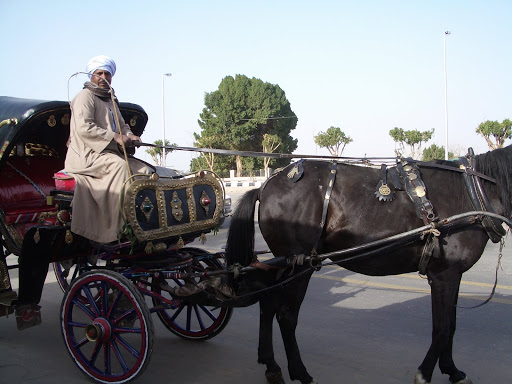
Carriages were our main form of transportation around town while we were in Luxor. You can get a ride across town for only a dollar!

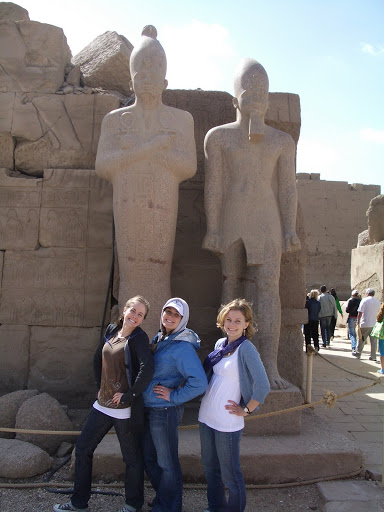
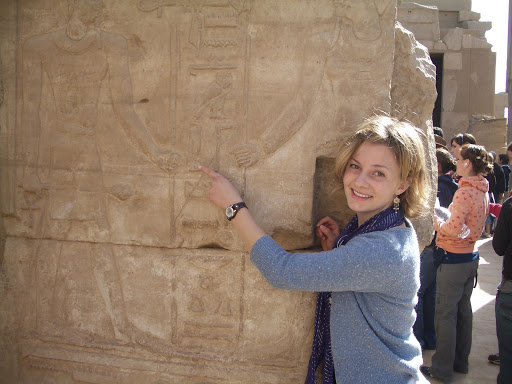
Throughout the Middle Kingdom and the New Kingdom, additions were made to the temple complex at Karnak by many Egyptian pharoahs, including Ramses I, Seti, Ramses II, and Merneptah. At the time of the exodus, Karnak was the center of religious life in Egypt, so in all likelihood, this is where Moses called the plagues down upon Egypt.

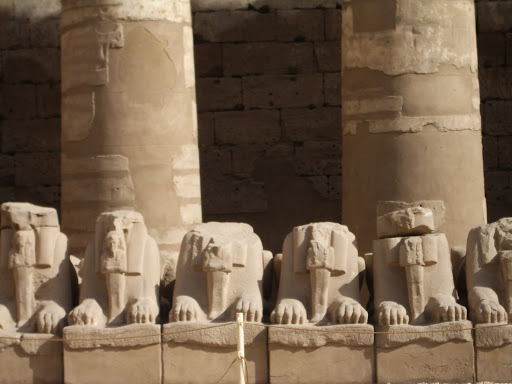
Sphinxes guarding the entrance to the temple (the heads have been removed).


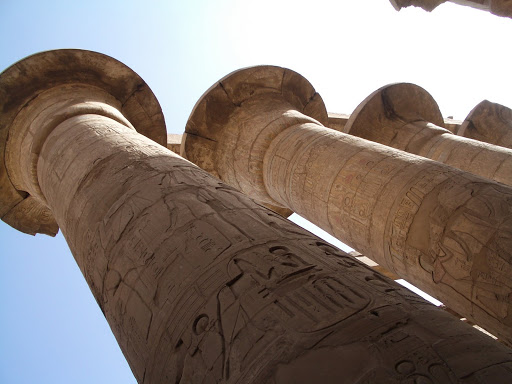
The Karnak temple complex is the largest temple complex in the world (even larger than Temple Square!). The pillars are so big that it takes eleven people to stretch around one of them. They are assembled of many large stones stacked on top of one another. Then they are chiseled to make them look smooth.

HOW TO MAKE AN EGYPTIAN TEMPLE

1. Lay the bottom stone of each pillar. Fill up sand to the top of the stones.
2. Set the next stone for each pillar on the base stone. Fill up sand to the top of the next stones.
3. Continue stacking on stones and filling up sand until the pillar has reached the desired height.
4. Construct the roof of the temple and decorate the ceiling (you won’t need any ladders or scaffolding to do this, since you’ve filled up sand to the top of the temple).
5. Drain a little sand from the temple and carve the tops of the pillars to make the stacked stones smooth so that each pillar looks like one stone. While you’re at it, carve relief images and hieroglyphics into the tops of the pillars, and paint them.
6. Drain some more sand and carve and paint the next section of the pillar.
7. Continue draining sand, then carving the pillars until you reach the bottom.

And there you have it! I expect all of you to try it and send me photos of the results.

Watch out! They spit!

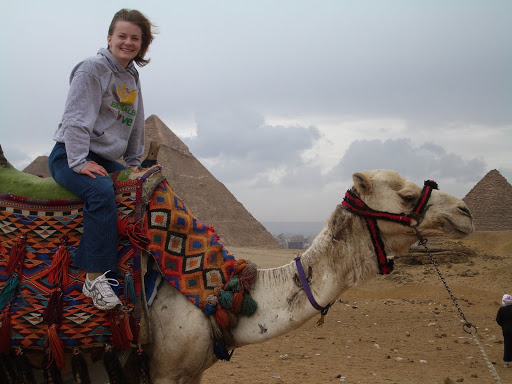
We had a lot of adventures on camels–at the pyramids at Giza and also in Luxor.

We crossed the Nile and took a camel safari on the west side of the river to see the “real Luxor.” We were the only Americans there, and we traveled through the village and through banana fields, onion fields, and fields of date trees. I harassed my camel guide to teach me as many Arabic words as possible–here is what I learned:

banana…mose
thank you…shukran
you’re welcome…afwan
good morning…sabaa al’khayr

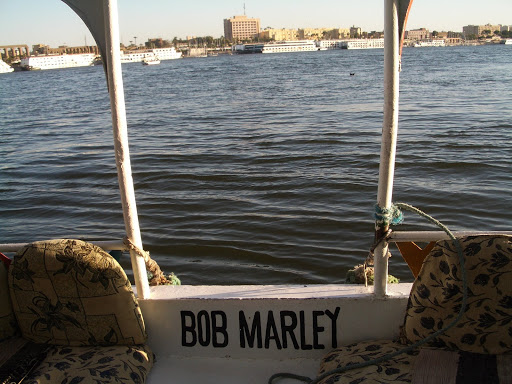
We took a boat ride down the Nile on the Bob Marley.

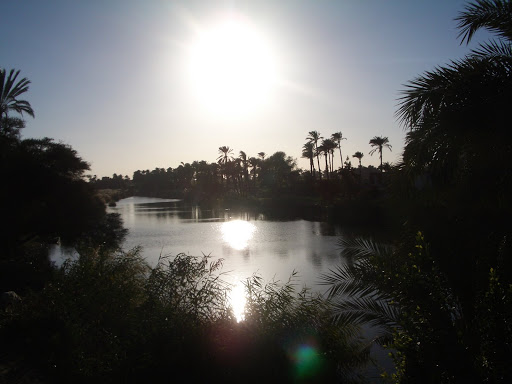
I made a great sketch of the sun setting over the Nile, but since you can’t see it, enjoy this photo instead.

High on the Mountain Top


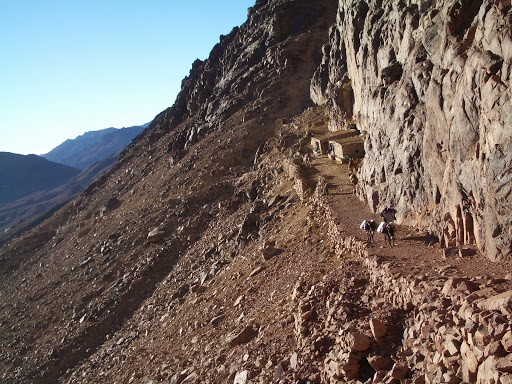
Sinai is exactly what you’d imagine it to be: dry. We drove for hours over sand dunes and flat ground so barren that not even sagebrush grew there. Once we had left behind all other human civilization, the flat dry ground turned to rocky and mountainous dry ground.

Mount Sinai and the eminences surrounding it are rugged and jut out of the earth. We set out at 3:00 AM to summit Sinai to watch the desert sunrise. Because we were hundreds of miles from any town or city, the stars were more abundant than I have ever seen them in my life; the whole sky glittered.

Along the trail, we were met by dozens of bedouin merchants who had gotten up in the middle in the night in hopes of making some money from us. “Camel? You need camel? Camel to the top?” “Coffee! Tea! Chocolate! We have!” “Need flashlight?”

The last half hour of the hike was up steep stone steps to the summit. We reached the top just as the first light was appearing over the horizon. I left our big group of students and went with a few friends to the edge of the cliff; we watched the sun rise in silence, then sang a few quiet hymns, including “High on the Mountain Top” and “For the Beauty of the Earth.”

We watched the sun slowly turn the deep blue of morning to its orange glow. I thought of Moses leading his people out of Egypt, and the great miracles that the Lord did for the Israelites. I thought of Brigham Young and my pioneer ancestors, and the great things that the Lord has done for me. Moses spoke with the Lord here more than three thousand years ago, I thought, and his covenant with Abraham is even older than that. But it still applies to me, and someday it will apply to my children, and theirs… To quote a favorite hymn:

For God remembers still
His promise made of old
That he on Zion’s hill
Truth’s standard should unfold

The Lord’s promises are being fulfilled in our day. That is why the most beautiful, breathtaking sunrise I’ve seen is on Sinai. The Lord is the light of our souls, and his promises and blessings are sure.

Stranger in a Strange Land


We’re back! I survived our eight-day sojourn in Egypt, and I experienced so many amazing and eye-opening things that it felt like a month instead of a week. For that reason (and because I’m exhausted), I’ll just post a few random things for now and a detailed overview of the trip can come later.

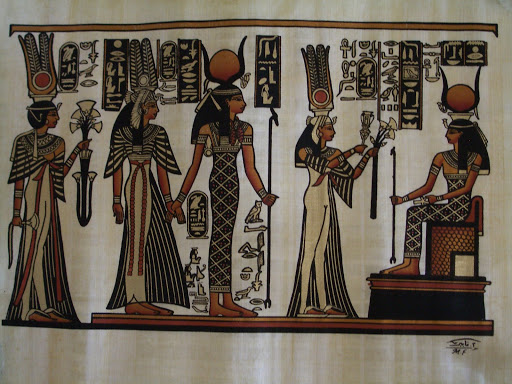
In Cairo we visited a papyrus factory, and this is the papyrus that I bought there, depicting the goddess Hathor, queen Nefertari, and others. We watched a papyrus-making demonstration.

HOW TO MAKE PAPYRUS

1. Slice off the green bark or outer covering of the papyrus stalk so that only the white core remains.
2. Cut the core into thin slices.
3. Pound the slices with a mallet and roll them with a rolling pin to make them all the same thickness.
4. Overlay the flat slices in a criss-cross pattern, the same way you make a lattice-work crust on a pie. Make sure there are no gaps in between.
5. Let dry.

The amazing thing about papyrus (especially for history’s sake) is how durable it is. Papyrus can be washed, dried, and re-used. If you tear it, you can fuse it back together with a little water. If you crumple it up, it won’t be damaged. Thank goodness for papyrus!

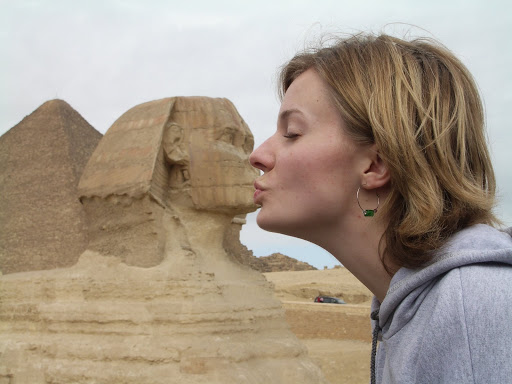
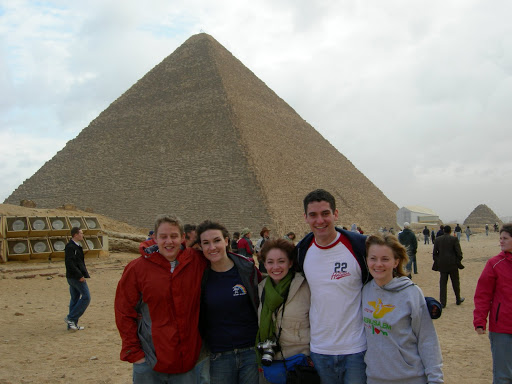
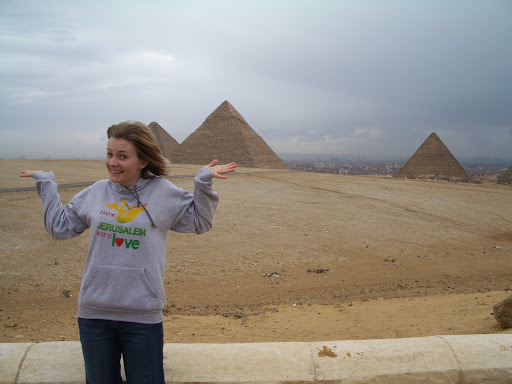
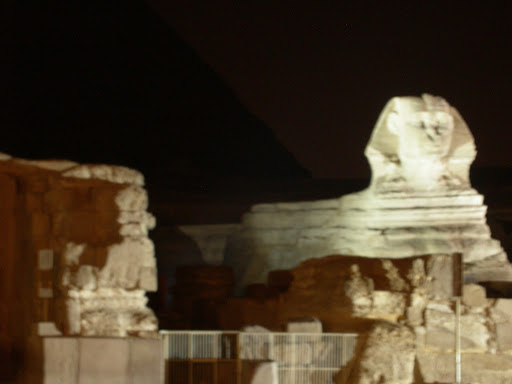
Going to the pyramids was fulfilling one of my lifelong dreams! I kept pinching myself to make sure it was real. It was incredible to stand in front of them and think, These monuments were five hundred years old when Abraham came to Egypt! By the time Moses was born, they were ancient! Now that is old.

We got to venture inside the second pyramid, the pyramid of Kaphre or Cephren. We crawled in the main shaft to the actual burial chamber where the pharoah was entombed. Of course, his mummy and his treasure have all been removed, but his stone sarcophagus was still there. The sarcophagus was carved from a single block of stone with such precision that even with our modern tools and technology it would be difficult to re-create it. In modernity the pyramid was first explored by Giovanni Belzoni in 1818, and he carved his name and the date on the wall inside the sarcophagus room.

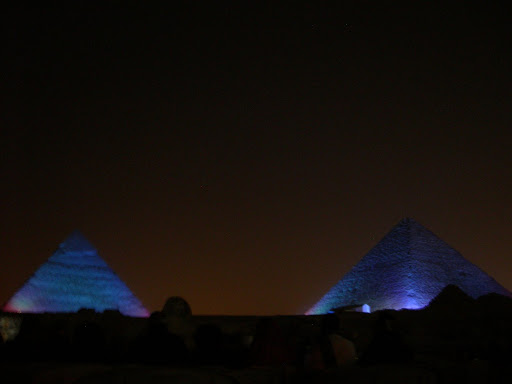
On our first night in Cairo, some friends and I decided to take a taxi to go to the Sound and Light show at the pyramids. The show was going to be in Spanish, but we decided that a light show at the pyramids was too cool of an experience to pass up, so we went anyway and I did my best to translate.

Gaza, Egypt, and Unrest

I have only been here three weeks, but it feels like months already. Or maybe a lifetime.

I was worried about living away from home for the first time, but fortunately I’ve been too buys to get terribly homesick. Between the heavy load of schoolwork I have here, the articles I write for work, and my sightseeing…um…obligations, I never have a spare moment. This semester seems pretty relaxing compared to last semester, however. Taking a full-time schedule of classes and working three jobs nearly killed me. : )

We weren’t allowed in the Old City yesterday. Since Tuesday there has been a lot of unrest because of the situation in Gaza. If you haven’t been following the situation there, here it is in a nutshell: Hamas launched airstrikes on Israeli settlements from Gaza, so the Israeli government shut off Gaza’s fuel and other resources. On Tuesday, Hamas operatives blew down the border wall between Gaza and Egypt, and now hundreds of thousands of Palestinians from Gaza are pouring into Egypt to buy fuel and food. More than seven miles of the wall has been torn down, and the refugees have been flooding the border ever since.

We are leaving for Egypt tomorrow morning for eight-day trip. We’ll be crossing the Israel-Egypt border sometime tomorrow afternoon. We’ll have an armed guard on each of our busses, and we’re all hoping that there won’t be any complications–keep your fingers crossed!

Jerusalem is a true melting pot of Muslims, Palestinian Christians, Russian Jews and Christians, and Jews from all nations. But once we cross the border into Egypt, we’ll be in a land that is almost entirely Muslim. It will be an eye-opening experience, I’m sure.

We wont’ have computer access in Egypt, so I won’t be posting for a while. I love you all! Until after Egypt!