Called to Serve!

Dear Sister Brown:

You are hereby called to serve as a missionary of The Church of Jesus Christ of Latter-day Saints. You are assigned to labor in the Argentina Córdoba Mission. It is anticipated that you will serve for a period of 18 months.

You should report to the Provo Missionary Training Center on Wednesday, December 29, 2010. You will prepare to preach the gospel in the Spanish language.

Your purpose will be to invite others to come unto Christ by helping them receive the restored gospel though faith in Jesus Christ and His Atonement, repentance, baptism, receiving the gift of the Holy Ghost, and enduring to the end. As you serve with all your heart, might, and strength, the Lord will lead you to those who are prepared to be baptized.

Greater blessings and more happiness than you have yet experienced await you as you humbly and prayerfully serve the Lord in this labor of love among His children. We place our confidence and pray that the Lord will help you become an effective missionary.

Sincerely,

President Thomas S. Monson

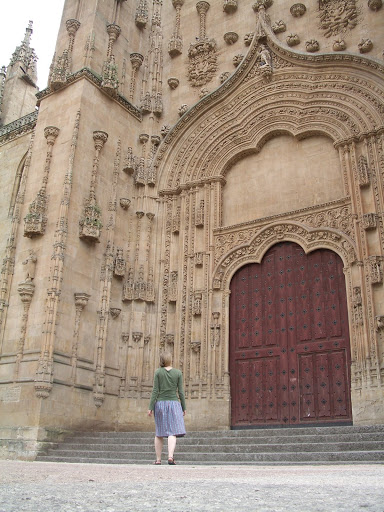
One of the oldest college towns in Europe

…is now my current place of residence. The University of Salamanca was founded in 1218, and it’s still a thriving center of learning for students from all over Spain and all over Europe. There are even a fair amount of American students here, since the University of Salamanca hosts a few Spanish language study abroad programs.

After five weeks of a traveling in a group, hopping from city to city, cramming in as many sights as possible, and working long archive days, Salamanca has been a perfect change of pace. I’m on my own, and I couldn’t be staying in a more perfect location. I’m on the Rua Mayor, the main street that connects the Plaza Mayor to the Cathedral. So I’m right in the middle of it all!

I’m on my own here in Salamanca, so aside from working in the archive in the morning, I do whatever I feel like. Which means I mostly just visit all the art museums in town, strike up random conversations with strangers I meet to practice my Spanish, and people-watch in the Plaza Mayor for hours on end, with the occasional break for helado. (I even broke down and purchased my first American food in Spain–una bola de Ben & Jerry’s Cherry Garcia–because there is a Ben & Jerry’s on the Rua Mayor! Throughout my time here, I’ve been determined to try as much Spanish fare as possible, so I’ve eschewed all American food. But I share a relationship with los señores Ben y Jerry that is so special that I don’t even know how to put it into words. So I succumbed.)

Oh, and I went to the cine last night–there’s an old theater in town that shows old Spanish movies. So I thought I would check it out. When I got there, though, it turned out that they’re currently doing a Brasileño movie series. So the film, from 1964, was a película Brasileña with Spanish subtitles. I was able to read all the subtitles and keep up with the film. But it was, honestly, the strangest movie I have EVER seen in my entire life.

I spent my Sunday afternoon in a FANTASTIC art museum, looking at the work of Alfonse Mucha, who was born in the present-day Czech Republic but who did much of his work in Barcelona. It really amazes me how much his style has perpetuated and influenced so much of our popular art, and how much he is still imitated today. (Just Google-image him and you’ll recognize him.)

So that’s my life right now: all morning while the Archivo Diocesano is open, I work with four-hundred year-old parish books searching out the genealogy of the Salas family, who are friends and clients of the Ryskamps. The research is going spectacularly and I’ve extended the family tree back two generations and added siblings too, woot woot! Then when the archive closes, I take my sketchbook and camera, like the tourist that I am, and go exploring.

Oh! And I gave a talk here in the Salamanca branch on Sunday! My first time speaking in church in Spanish (I hope I have occasion to do it again!). I’m really proud of myself because my talk was more than ten minutes long, and I was able to speak a lot of it from memory rather than just reading it. Since I came to Spain, I’ve been learning Spanish like crazy—but when I gave my talk it was like something magical clicked in my brain and now I really truly speak Spanish. I don’t know how to describe it. But it’s a really cool feeling.

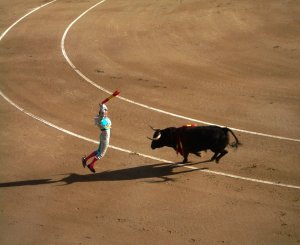
Toro! Toro!

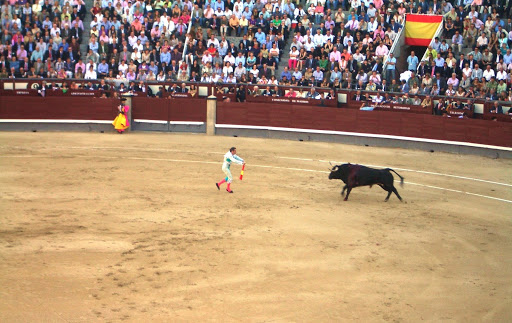
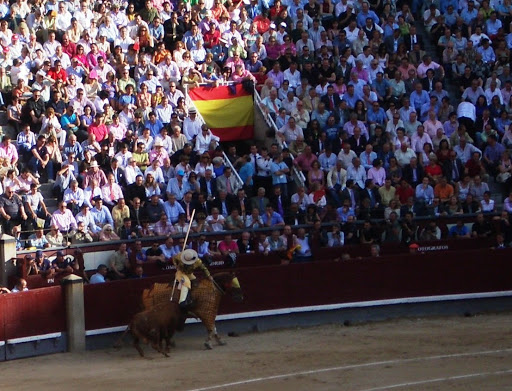
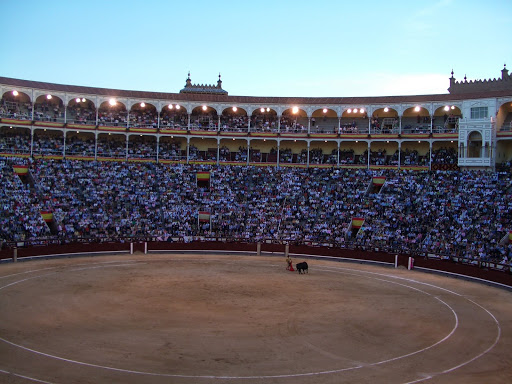
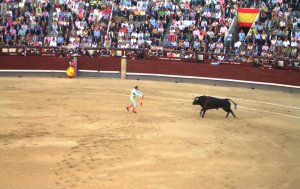
A ticket to the bullfight in the Plaza de Toros in Madrid gets you a seat in the amphitheater to watch six bullfights. A traditional Spanish bullfight, or corrida, has several stages.

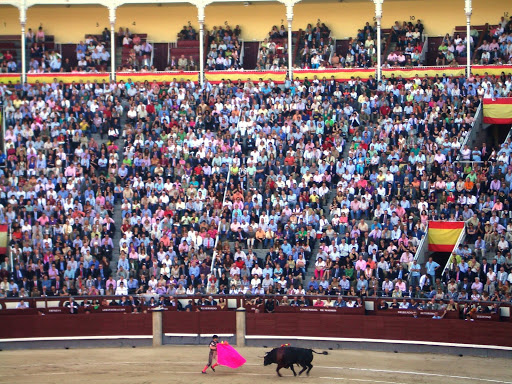
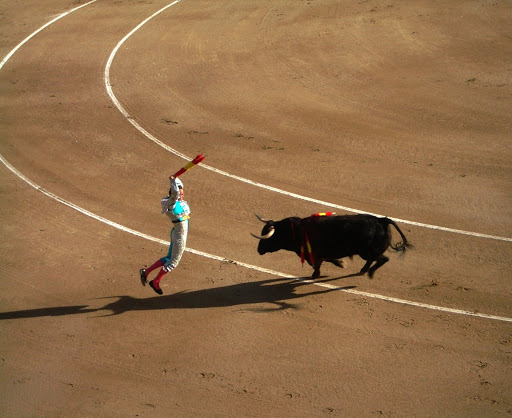
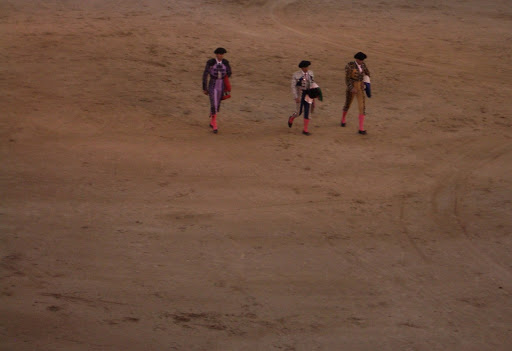
First, the bull is released into the ring and the banderilleros, with their colorful pink capes, come out and taunt the bull and then dodge behind the protective wooden partitions. The idea, of course, is to show off to the crowd how dangerous the bull is (and allow the matador, watching from the sideline, to get an idea of the bull’s speed and strength).
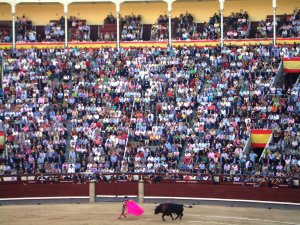
Mounted on their heavily padded horses, the mounted picadores take on the bull. As the bull tries to ram its horns into the horse, the picadores drive their long spear into the bull’s back. The idea is to get the bull to lower its head to prepare for the real bullfight. If the bull won’t relent from ramming the horse, the banderilleros try to distract the bull with their capes.

Next the matador comes out into the ring. He is the real star of the show. If he wants to, he can dedicate the bull to an individual or the crowd. Before killing the bull, there are six hooked sticks that he links onto the bull’s back. He hooks them on two at a time by masterfully luring the bull to him, hooking the sticks, and then dodging out of range of the bull’s deadly horns, all within the blink of an eye.
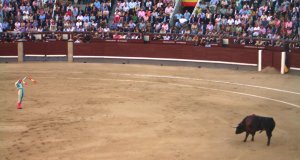
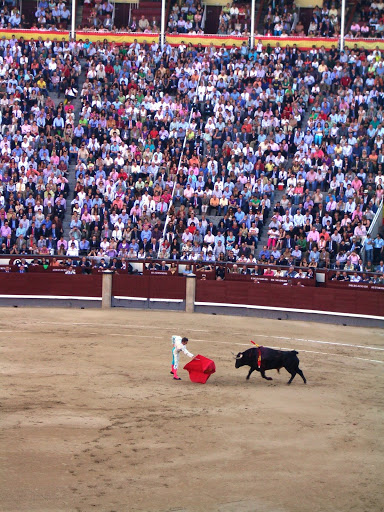
Next comes the climax of the corrida. The bull’s back is now covered in blood from the picador’s spear and the six hooked sticks hanging from it. The sticks themselves make the corrida more exciting and more dangerous; they are jabbed into the bull and flapping at his sides, irritating him and making him angrier and more determined to charge at the matador. It is now the matador’s task to kill the bull by stabbing a short sword into the base of the bull’s neck. This must be done with precision, because if the bull isn’t killed instantly and has to suffer, the crowd will boo the matador from the stadium. However, the kill must be done quickly, because the matador has to reach over the bull’s horns and stab it in the base of the neck as the bull is charging at him. The matador uses his red cape to lure the bull (only matadors can use the red cape; the capes of the banderilleros are pink).
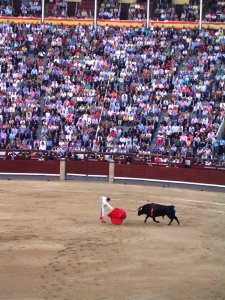
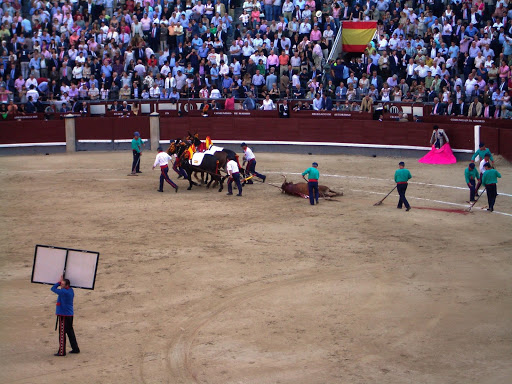
Once it is all over and the bull has been killed, one of its ears is cut off and saved as a souvenir or trophy for the matador or for one of his sponsors. An announcer comes out bearing a sign that lists the bull’s age and weight and the bull-breeding company he came from; the sign-bearer shows this to the crowd. Then a team of men comes, throws a rope around the bull’s neck, and attaches it to a team of horses. Then the carcass of the bull is dragged around the ring and then out of the stadium, leaving a trail of blood behind it.

Every part of the bullfight is an art form. If the picadores drive the spear into the bull’s back too much, and the bull loses too much blood, then the bull will be weakened and it will be a lame bullfight. If, however, the picador doesn’t get the bull to lower his head enough, the matador could be injured or killed. Likewise, the matador has to kill the bull in one quick, clean stroke—there is no room for error. As he artfully lures the bull to him and then dodges just out of death’s reach, the matador’s graceful movements are as much dance as they are any kind of sport. In fact, the results of each night’s bullfight appear in Madrid newspapers in the arts section, next to theater and dance reviews, rather than in the sports section with the results of soccer games.
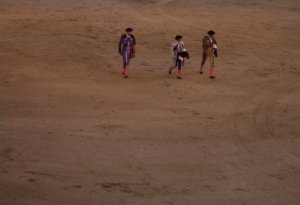
But of course, the real draw of the bullfight is its quick-paced action and risky excitement. The matadors literally stare down death. We watched six corridas; during one of them, the bull charged at the picador with so much force that the picador was knocked from his horse and over the wall into the crowd! And it took the help of all the banderilleros and two referees to distract the bull, calm the horse, and get the picador safely mounted on his horse again to continue the corrida. The scariest moment, though, was during the third corrida. The matador lured the bull over but as he went to stab him, the bull was too quick. He rammed the matador off his feet and we watched in horror as the bull proceeded to stamp his feet over the matador’s body. One of the banderilleros ran out to distract the bull while the others picked up the matador and carried him unconscious from the stadium, his head bleeding profusely. The crowd all stood up for the matador as he was carried from the ring. I don’t know what happened to him or how badly he was injured.

So is it violent? Extremely. Bloody and violent and not for the faint of heart. But also really exciting, and a truly Spanish experience. Every city in Spain—from booming Madrid to the tiny little pueblos—has its own plaza de toros. Since Spain was the first place after the Italian peninsula to be conquered by Rome, it’s no wonder. You can see how the human vs. animal fights carried out in the Roman amphitheater evolved into this very old Spanish tradition.

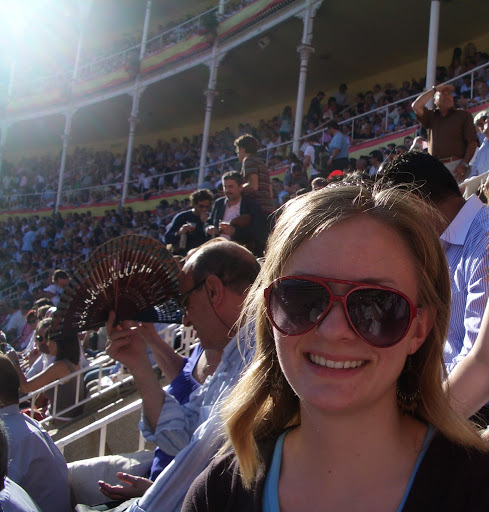
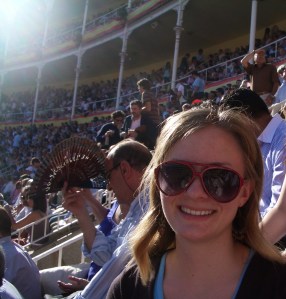
Our seats were in row 18, about a third of the way up from the bottom. We were surrounded by old Spanish men who puffed their cigars and yelled agitatedly to whoever would listen: “No, no, no…ahora si!” “Ay ay ay!” “Que fuerte el toro!” That was probably the most fun thing about it: the atmosphere. The band played and air pulsed with the beat of thousands of people fanning themselves with Spanish paper and wood fans to try to keep cool under the hot sun. We sat in the plaza de toros that has housed Madrid’s bullfights for eighty years. We breathed in all kinds of cigar smoke and watched six bulls get slaughtered, and I think it’s the most fun I’ve had in a long time.
Pilgrimage

Whan that Aprille with his shoures soote
The droghte of Marche hath perced to the roote,
And bathed every veyne in swich licour,
Of which vertu engendred is the flour;
Whan Zephirus eek with his swete breeth
Inspired hath in every holt and heeth
The tendre croppes, and the yonge sonne
Hath in the Ram his halfe cours y-ronne,
And smale fowles maken melodye,
That slepen al the night with open ye,
So priketh hem nature in hir corages:
Than longen folk to goon on pilgrimages,
And palmers for to seken straunge strondes,
To ferne halwes, couthe in sondry londes;
And specially, from every shires ende
Of Engelond, to Caunterbury they wende,
The holy blisful martir for to seke,
That hem hath holpen, whan that they were seke.

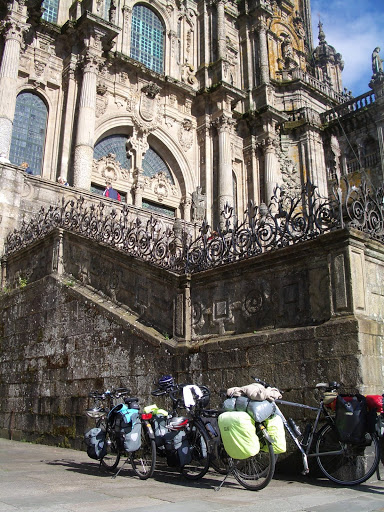
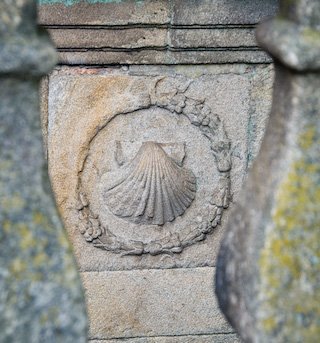
After the remains of Saint James the Apostle were discovered–Queen Helena style–in this little Galician village in the ninth century, it became a booming pilgrimage site. In fact, at its height in the 1300s, Santiago surpassed Jerusalem and Rome in the number of Christian pilgrims who visited it. There were many different pilgrimage routes to the town–“caminos de Santiago”–but all led to the same place. Christian pilgrims who made it all the way to their destination, at the far end of Spain, near the Galician coast, took home a scallop as proof that they had reached Santiago. The scallop also became a symbol of the Santiago de Compostela pilgrimage: like the ridges on a scallop, all the pilgrimage routes started at different places but ended at the same spot.

Today Santiago de Compostela is still packed with visitors–instead of Christian devotants with pilgrim staffs, they are backpackers and cyclists who have come for hundreds of miles on one of the various caminos de Santiago. And just as they did a thousand years ago, they all gathered in the cathedral at noon for the pilgrims’ mass. The priest offered a beautiful sermon in Spanish about devotion to God. Then masses were sung in Latin, and we all took communion.

Then came the part that everyone was waiting for. There was a huge incense burner suspended by a thick rope from the ceiling in the middle of the chapel. It was packed with incense and lit. Then a group of about six men pulled on the other end of the rope–like a pully–and hoisted the giant incense burner, called the botafumeiro, into the air. Then they started it swinging. It swung back and forth, longways through the cathedral. Then they let more rope out and got it swinging even further, so that it was swinging all the way to the ends of the cathedral! It was unreal!

And of course, the mass itself was very moving. The priest’s message was simple but rang true. And all the modern-day pilgrims, with their hiking boots, unwashed hair, trekking poles, had traveled hundreds of miles to hear it, and to partake in the spirit of pilgrimage.

So, on the subject of pilgrimage, I’ll never forget the words of my Jerusalem professor, Brother Seely, at the end of our four-month journey: “We came here for various reasons–academic learning, personal growth–but really we all came here to go on pilgrimage. And we’ve visited all kinds of holy sites, and this has been a pilgrimage through space. But you’ll come back to the Jerusalem Center twenty years from now and someone else will be sleeping in your bed. It won’t be the same. So it’s actually a pilgriamge through time. And you can’t go back. But the rest of your life will be different because you made this pilgrimage. And you’ll always remember it.”
A Weekend in Hervás

When I told people that I was coming to Spain, many of them asked where in Spain I would be. The answer to that is that I’ll be traveling all over, working in different archives and researching different families, in many different cities, including:

Segovia
Salamanca
Ávila
Madrid
Toledo
Cáceres
Garganta la Olla
Valladolid
Santiago de Compostela
Cádiz
Granada
Sevilla

So we’ll be hopping from city to city, scrambling to get as much genealogy work done as we can. But out of all the different cities we’ll be staying in, we’re spending five nights in Hervás. So it’s our home away from home—or the closest thing to it.

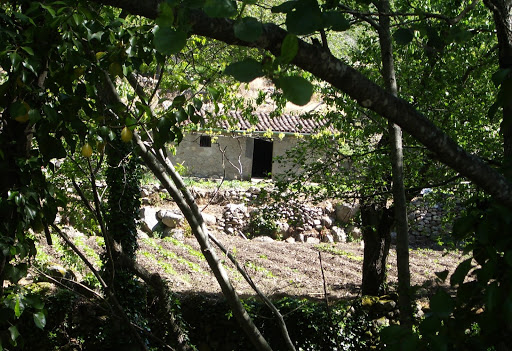
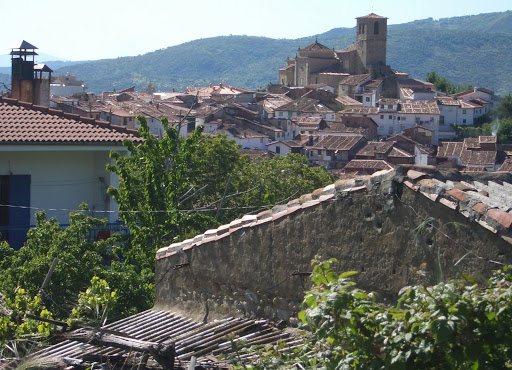
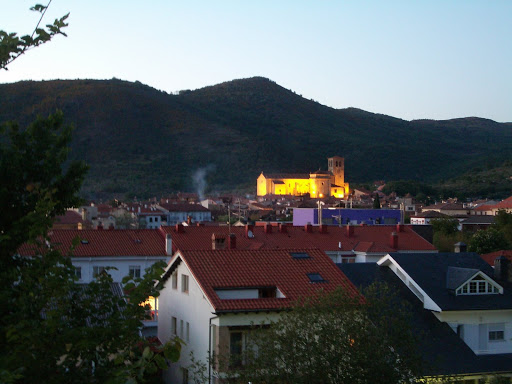
Hervás, unlike the big cities we’ve seen so far, is a quintessential Spanish pueblo, tucked up in the mountains, far away from everything. We’re staying in a little house along the river.

I love it here—it’s so peaceful and friendly. The hills are all terraced and dotted with olive trees; everyone spends the morning cultivating their land; the vegetables from the open-air mercado are sublime; and the power in the little house goes off if we try to run more than one appliance at once. : ) Really, it’s charming, and I’ll be sad to leave it. Fortunately, we’re coming back later in our trip.

Segovia!


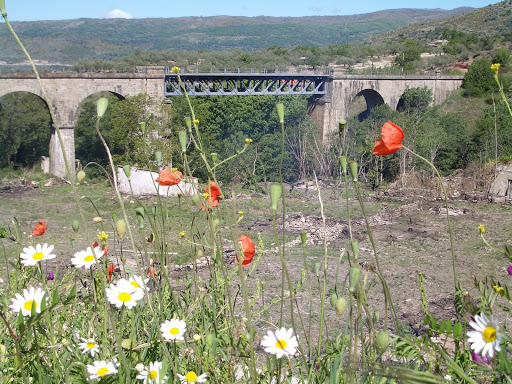
This aqueduct was built by the Romans before the time of Christ.

So long, Family History Library. This is where I do my research now:

At the Archivo General Militar de España in Segovia, which also happens to be the castle where Ferdinand and Isabella lived for much of their married life.

It was everything I ever imagined a castle to be, complete with turrets, tapestries hanging on the walls within, a throne room where Ferdinand and Isabella held court, an entire armory room filled with swords and suits of armor, and even a dungeon.

I love you all and I miss you! I’ll post more when I can.

: )

I’m Back!

So after a long hiatus from my blogging life, I’ve decided to re-enter the blogging world so that I can record more of my random thoughts and experiences–since, it turns out, there is life after Jerusalem, after all.

So in the six months since I last posted I have:

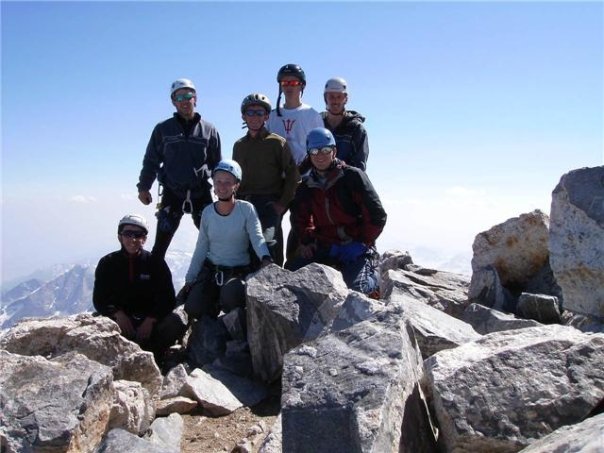
Climbed the Grand Teton.


Me and my dad, uncles, and brothers on the summit.

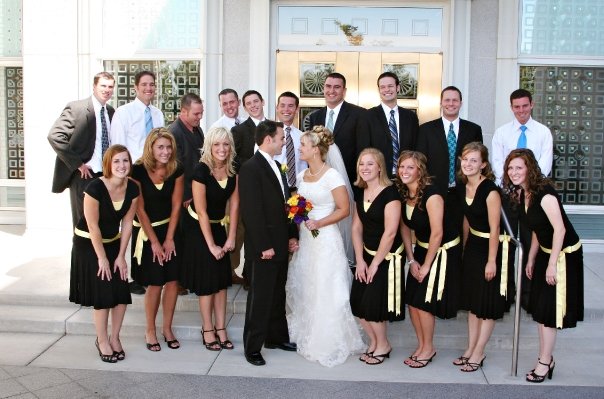
Been a bridesmaid and married off two of my best friends.


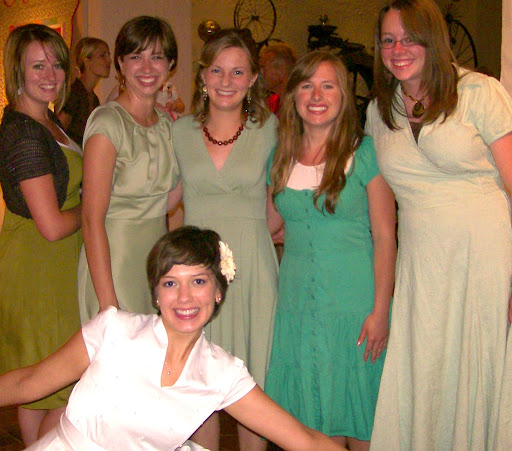
Jana, Jessica, me, Heather, Samantha, and our beautiful bride Carrie. (Carrie’s mom made her dress! Isn’t that amazing? P.S. This photo is courtesy of Samantha.)


Davy Bennet and Kristi Torgerson…no, wait! She’s a Bennet now. Weird how marriage will do that to you. (Photo courtesy of Mindy Tuikolovatu.)

Enjoyed time with my delightful, inspiring, hilarious family.

And in between all that there’s been lots of school, work, football games, genealogy, rock climbing, road trips, and everything else that makes life great.

Palm Sunday in Jerusalem

On Sunday we joined with thousands of Christian pilgrims in the Palm Sunday procession to Jerusalem.

The procession began at Bethphage, the church marking the spot where Christ mounted the donkey to begin his journey into Jerusalem. There were swarms of Palestinian boys selling palm branches; I bought one for three shekels and joined the rest of the worshipers at the top of the hill. The procession began.

There were people from every country and every walk of life imaginable. I detached myself from the BYU JC crowd to have a more authentic cultural experience. On Palm Sunday, it’s all about the journey.

Along the way, I talked to a woman from Holland who was here with her family. I met two girls my age who were studying conflict resolution at Hebrew University. I walked for a while with a retired couple from Missouri. I walked beside a Polish Catholic group, all dressing in matching uniforms displaying the Polish flag. There were Boy Scout groups from Jericho. There were a few young families there, the daddies carrying their toddlers on their shoulders. There were nuns who had donned baseball caps under their white habits so that their faces wouldn’t get sunburned.

I walked with the processional band, a marching band of sorts, except that it had guitars and hand drums and tambourines. The crowd walked in rhythm and we waved our palm branches in the air, doing our best not to hit anyone in the eye, since the crowd was so thick that we were all elbow to elbow. We sang “Ho-oh-sha-ah-na, ho-oh-sha-ah-na, hoshanna!” There were so many people that the procession reached from the top of the Mount of Olives all the way down into the Kidron Valley.

The singing and celebration continued all the way down into the city through Stephen’s Gate. The band led the crowd into the courtyard of St Anne’s Church; I didn’t know how it was possible to fit that many people into the court, but somehow we all made it.

The festivities didn’t stop at St Anne’s; the band continued to play and everyone danced, including the clergy! The nuns led a line dance, the monks joined in our dance circle, and we all rocked out. My favorite, though, was a Catholic tour group from Spain. Spanish people know how to dance, I tell you what!

After about an hour the merriment had died down, and then the bishop of St Anne’s stood and spoke. He must have translated his speech beforehand, because he read it in Spanish, then Russian, then Arabic, then Hebrew, and finally in English.

He said that we had all come to the Holy Land for different reasons, but we had all come on pilgrimage. He prayed that God would bless Jerusalem with peace. He said that even after we left Jerusalem, it would forever be a part of us. He said that the sacredness of the sites would enter into our souls. He said that it was our responsibility to carry the spirit of Jerusalem to the world. And when he spoke, I knew that his words were true.

So here is my message from Jerusalem, from Palm Sunday:

The Old Testament, the New Testament, the Book of Mormon, and the Doctrine and Covenants all weave together to form a testimony of Jesus Christ. That is because he is the same yesterday, today, and forever. He is the god of the Old Testament. He did come to earth as our Savior.

He does not forget his promises to us. He is the Savior of the entire world: the Jews, the Americans, everyone. He overcame death and sin. He will gather his people again in the last days. Israel will be gathered, and Christ will be our king when he comes again. He will be king over all the earth.